
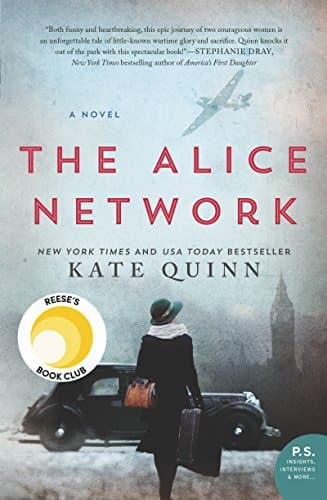
The Alice Network Book Review – Kate Quinn's WWII Spy Novel
Quick Verdict
Pros
- Dual timelines keep you flipping pages late into the night
- Real historical backdrop (the actual Alice Network spy ring) adds weight
- Eve and Charlie are fully fleshed characters you genuinely root for
- Rich period detail without feeling like a textbook
- Emotional payoff lands hard — expect to ugly-cry
Cons
- Pacing dips during the WWI timeline sections for some readers
- Several triggering content warnings apply (war violence, addiction, assault)
- Not a fast-paced action thriller — it builds slowly through relationships
- The romantic subplot feels somewhat predictable
Quick Verdict
Kate Quinn's The Alice Network book review starts here: this is historical fiction that earns its bestseller badge. The dual-timeline structure, two fully-realized female leads, and a spy network rooted in real history make it a standout. It pulled me in on a slow Tuesday and I didn't surface until 2 AM finishing the last chapter. Recommended for anyone who wants a story about women surviving impossible circumstances — score: 8.7/10.
What Is The Alice Network?
The Alice Network opens in 1947, with a heartbroken college girl named Charlie St. Clair sneaking onto a ship bound for England. She's not running from classes — she's running from a pregnancy she can't acknowledge and a family that wants her problems to disappear quietly. What she wants is her cousin Rose, missing for two years after the liberation of a French internment camp. Nobody will help her find Rose. So Charlie does what any stubborn 20-year-old from privilege does when the world says no: she ignores it and goes looking herself.
Her path crosses Eve Gardiner's in a crumbling English country house. Eve is old, half-broken, and drinking herself into a quiet grave. During World War I, she was part of the real Alice Network — a real-life ring of female spies run by Louise de Bettignies that fed intelligence to the British during the Great War. Eve survived things she has never spoken about. Charlie, without quite understanding what she's asking, wants Eve to remember.
Key Features
- Dual narrative spanning WWI (1915–1918) and post-WWII 1947
- Based loosely on the historical Alice Network spy ring run by Frenchwomen
- Two complex female protagonists with distinct voices and arcs
- Rich period atmosphere — the trenches, London under bombing, occupied France
- Emotional depth exploring trauma, loyalty, grief, and female friendship
- Published by William Morrow; over 500 pages of substantial reading
- Strong book club discussion potential with reading guides available
Hands-On Review
I picked up The Alice Network because a friend pressed it into my hands with the words "you will not sleep." She was right, though not in the way I expected. The sleep loss came not from action — Quinn doesn't rely on shootouts and car chases — but from the quiet, creeping dread of knowing where Eve's story is heading while Charlie still thinks this is a simple missing-person case.
What surprised me most was how different the two timelines feel as reading experiences. The 1947 sections are intimate and almost claustrophobic — Charlie's desperation, Eve's walls crumbling under liquor and memory. Then Quinn cuts to 1915, and suddenly you're in the mud of the Somme region, in safe houses and coded messages, watching a young woman discover that courage and naivety look identical until someone gets caught. The pacing isn't even, I'll admit. The WWI portions are denser, slower, richer. The 1947 sections move faster, driven by Charlie's urgency and the growing dread of what Eve is finally ready to say.
The characters carry the weight. Eve Gardiner is one of those rare protagonists who feels like a complete person by the first chapter — prickly, guilt-ridden, funny in small moments when she forgets to guard herself. Charlie is easier to dismiss initially (privileged, impulsive, a bit naïve), but her arc earns her complexity. By the midpoint, I was genuinely anxious about both of them, which is harder to pull off than it sounds in dual-narrative fiction.
Quinn's research shows. The real Alice Network existed; Louise de Bettignies died in a German prison camp. Quinn didn't invent the spy ring — she built fiction around it, imagining who among the operatives might have been and what they might have survived. That grounding gives the novel a gravity that purely invented spy thrillers lack.
Who Should Buy It?
Pick this up if you want historical fiction that treats women as fully human — complicated, cowardly in moments, heroic in others, never reduced to archetypes. It's a natural fit for book clubs, for readers who enjoyed Lilac Girls or The Nightingale, and for anyone who enjoys a slow-burn story where the tension builds because of what characters won't say rather than what they do.
Skip this if you need fast-paced action — The Alice Network is a character study wrapped in a spy story, not a James Bond novel. It's also not right for you if you're looking for a light read; the content is emotionally heavy and covers war trauma, addiction, and sexual violence. And if you bounce off dual-timeline structures in general, this one won't convert you.
Alternatives Worth Considering
If The Alice Network hooked you, Kate Quinn's The Huntress takes on WWII from a different angle — a female Nazi hunter in 1950s Alaska. Same research depth, same female-centered lens, different setting. For readers who prefer the The Nightingale vibe (Kristin Hannah's wartime sisters in occupied France), that one delivers a more linear narrative with comparable emotional stakes. And if it's the dual-timeline format you loved, try Susan Meissner's Lady in Waiting, which threads contemporary and 1600s storylines through a different lens entirely.
FAQ
The novel is fiction, but Kate Quinn built it around the real-life Alice Network — a World War I spy ring of women run by Louise de Bettignies. Quinn researched historical records to ground her fictional story in real events.
Final Verdict
The Alice Network earns its place on the bestseller shelf. Quinn takes real history — the women who spied for Britain while the world told them to stay home and knit — and makes them breathe. Eve and Charlie's intersecting journeys are uneven in places, but the destination justifies the road. It's a book about what women survive and who they become afterward. Will I keep it on my shelf? Yes. Will I lend it to everyone I know? Almost certainly.