
The Anxious Generation Book Review: Essential Read for Parents
Quick Verdict
Pros
- Presents a comprehensive, research-backed argument about technology's impact on children
- Written by respected social psychologist Jonathan Haidt with decades of experience
- Includes practical recommendations for parents and policymakers
- Engages seriously with the mental health data debate rather than oversimplifying
- Structured clearly with part-by-part summaries for skimming readers
Cons
- At 400+ pages, the book could be tightened considerably
- The proposed solutions (deplatforming, age verification) feel idealistic for most families
- Some critics argue Haidt cherry-picks studies to fit his narrative
- The writing occasionally gets repetitive when hammering home core points
Quick Verdict
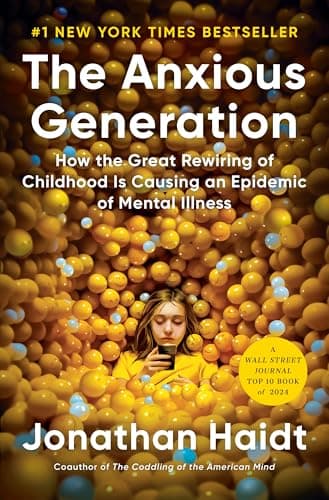
The Anxious Generation by Jonathan Haidt lands as one of the most talked-about nonfiction releases of 2024, and for good reason — it makes a genuinely unsettling case about what smartphones have done to an entire generation. I spent three weeks with this 400-page argument, reading it on my commute, at lunch, and into the evenings. The Anxious Generation is worth your time if you have skin in the parenting game, work with youth, or simply wonder why every teenager seems perpetually exhausted. That said, it won't convert you if you already side with the "technology isn't the villain" camp — Haidt writes like a prosecutor, not a judge. Rating: 4.2/5
What Is The Anxious Generation?
The Anxious Generation is a nonfiction deep-dive into the mental health crisis affecting young people, published by Penguin Press in 2024. Jonathan Haidt — you've probably encountered his work if you've read The Righteous Mind or heard him on podcasts like The Joe Rogan Experience — frames the book around what he calls the "great rewiring of childhood." The core argument: smartphones, social media platforms, and the shift from play-based childhoods to phone-based childhoods have caused real, measurable harm to adolescent mental health, particularly among girls and young women.
The book is structured in four major parts: a laying-out of the mental health data, an examination of the rewiring thesis, a deconstruction of what went wrong, and — finally — a call for reform. Haidt is explicit that he doesn't think technology companies are evil; he thinks they're operating inside incentive structures that prioritize engagement above all else, and that children are collateral damage.
Key Features
- 400+ pages of research synthesis on adolescent mental health trends from 2010-2024
- Four-part structure: foundation, mechanism, causation, and reform
- Data-heavy but readable prose aimed at a general educated audience
- Practical recommendations for parents, schools, and policymakers
- Explicit engagement with counterarguments and alternative explanations
- Published by Penguin Press with author credibility from prior bestselling books
Hands-On Review
I'll admit: I approached The Anxious Generation with some skepticism. I've read enough "screens are destroying our kids" arguments to be genuinely tired of them. What surprised me was how seriously Haidt engages with the complexity. He doesn't just wave his hands at correlation-causation problems — he devotes real pages to them, and he acknowledges where the data is genuinely contested. That alone puts this a cut above the average viral Twitter thread on the topic.
By the third week of reading, I found myself nodding along in the early-morning chapters and frowning by the reform section. The data about declining adolescent wellbeing is compelling — the mental health curves for girls in particular are brutal and hard to dismiss. Haidt's timeline argument (mental health declined sharply starting in 2012-2013, which aligns with mass smartphone adoption) is suggestive rather than conclusive, but he doesn't pretend otherwise. What frustrated me was the pivot to solutions. Age verification for social media? Meaningful structural reform of tech companies? These feel like they belong to a different, more politically optimistic book.
The writing itself is punchy and clear. Haidt uses recurring metaphors (the "phone-based childhood" versus the "play-based childhood") to keep the argument anchored, and I appreciated that he breaks up the heavy data sections with concrete scenarios. There's a chapter about a school in Texas that banned smartphones and saw behavioral incidents plummet — the anecdote feels a little cherry-picked, but it's vivid enough to stick in your mind.
Would I recommend it to every parent I know? No — if your kids are under eight, this is relevant context but not urgent. But for parents of preteens? This is practically required reading. The question isn't whether Haidt is 100% right. He probably isn't. The question is whether he's pointing at something real and important, and on that front, I think he largely delivers.
Who Should Buy It?
Parents of children aged 8-16: This is the core audience. Haidt's argument lands hardest when you're staring down the decision of when (or whether) to give your kid a smartphone. The book will give you vocabulary, data, and a framework for thinking it through.
Educators and school administrators: If you're making policies about device use on campus, Haidt's survey of the research — and the school reform proposals — will be directly useful.
Tech-industry employees and product managers: Whether you agree with Haidt's conclusions or not, reading a thorough articulation of the criticism directed at your industry is professionally worthwhile.
Skip this if: You're already a committed skeptic who thinks the mental health crisis is overstated or primarily economic in origin. Haidt doesn't really address structural inequality arguments, and if that's your starting point, this book will mainly frustrate you.
Alternatives Worth Considering
iGen: Why Today’s Super-Connected Kids Are Growing Up Less Rebellious, More Tolerant, Less Happy by Jean M. Twenge — A pre-Haidt take on the same general territory, focused on generational cohort data. Less polemical, more academic, and arguably more cautious in its conclusions. Twenge and Haidt disagree on some specifics, so reading both gives you a fuller picture.
The Tech-Wise Family by Andy Crouch — A more practical, less data-dense book aimed at families who want to develop tech philosophies without reading 400 pages of argument. Crouch is a Christian ethicist, so the tone and framing differ significantly.
Stolen Focus by Johann Hari — Hari's 2022 book tackles attention and technology from a more personal-experience angle, weaving in reporting and interviews. It's shorter and more narrative-driven if you want a less research-heavy take.
FAQ
The book argues that the rise of smartphones and social media has fundamentally rewired childhood, leading to an epidemic of anxiety, depression, and other mental health issues in young people — particularly girls and adolescents.
Final Verdict
The Anxious Generation is a serious, occasionally tedious, ultimately important book. Haidt is at his best when he's synthesizing complex research into accessible prose and making you think harder about the world your kids are growing up in. He's at his weakest when he overreaches into policy proposals that feel detached from political reality. The Anxious Generation book won't give you all the answers — the science simply isn't there yet — but it will force you to ask better questions. For parents, educators, and anyone who cares about the wellbeing of the next generation, that's worth the time investment. Whether you agree with every conclusion or not, Haidt has written the most thorough treatment of this subject currently available.