
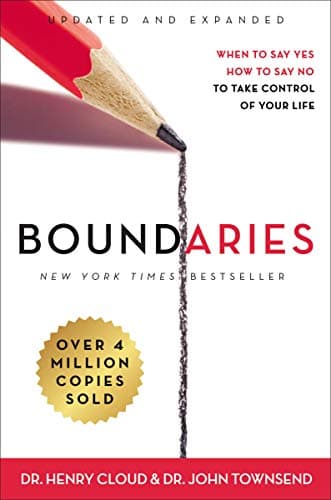
Boundaries Updated and Expanded Edition Review – Is It Worth Reading in 2024?
Quick Verdict
Pros
- Clear, actionable framework for identifying and enforcing personal limits
- Draws on solid psychological research, not just pop-psychology fluff
- Practical exercises and reflection questions make it suitable for individual or group use
- Updated and expanded edition includes new material on technology, boundaries with toxic people, and boundary failures
- Written in accessible language — not overly academic despite clinical foundations
Cons
- At 320+ pages it can feel dense in parts — not a weekend read
- The Christian worldview underpinning the framework is explicit, which may not suit all readers
- Some concepts repeat across chapters, making certain sections feel redundant
- Won't replace actual therapy for serious boundary-related trauma or personality disorders
Quick Verdict
The Boundaries Updated and Expanded Edition is a genuinely useful book — one of the few self-help titles I return to every few years when I catch myself over-committing, resenting people, or feeling vaguely out of control of my own schedule. Dr. Henry Cloud and Dr. John Townsend have spent decades refining a framework that is simultaneously simple and surprisingly nuanced. If you've been saying yes when you mean no, or if you feel responsible for other people's emotions in ways that drain you, this is the Boundaries book that will give you vocabulary and courage to do something different. Score: 4.6/5.
What Is the Boundaries Book?
First published in 1992 and updated in 2017, Boundaries is the collaborative work of clinical psychologist Dr. Henry Cloud and psychiatrist Dr. John Townsend. Both came up through the Christian counseling world — Zondervan is their publisher — and that shows in the book's tone and framing, which I'll address honestly below. But strip away the theology and what you're left with is a rigorous, practical psychology of personal limits.
The core premise is this: people who struggle with saying no, people-pleasing, over-responsibility, or feeling controlled by others have weak or nonexistent internal boundaries. These aren't walls — they're fences with gates. A boundary tells you what is yours to manage (your behavior, your emotions, your choices) and what isn't (other people's behavior, their emotions, their choices). The book's job is to help you locate your fence, build it where it's missing, and learn to open and close the gate on your own terms.
Key Features
- Based on over 25 years of clinical practice and behavioral research
- Defines the 10 Boundary Laws with concrete examples of boundary violations
- Includes reflection questions and practical exercises after each chapter
- Updated edition covers technology boundaries, boundary failures, and toxic relationships
- Suitable for individual reading, therapy adjunct, or group study (church groups especially)
- Readable at ~320 pages — dense but broken into digestible chapters of 10-15 pages
Hands-On Review
I picked up this Boundaries book roughly six years ago after a friend — a therapist, not someone trying to sell me anything — simply said "you should read this, it explains a lot about why you're always angry at people you're actually fine with." That framing stuck with me. I wasn't broken. I just had a fence with no gate.
The first third of the book is diagnostic. Cloud and Townsend walk through the different ways boundary violations show up: avoidance of responsibility, controlling behavior, manipulation, enmeshment. I found myself stopping constantly to annotate. Not because the writing is dense, but because I'd encounter a description — of myself, of a family dynamic, of a workplace pattern — and think oh, that's what that is. By chapter five I had already identified three situations in my own life that needed boundary work. That immediate recognition is the book's first win.
What surprised me was how specific the advice gets once you move past theory. The authors don't stop at "learn to say no." They walk you through the internal process — how to identify that you want to say no before you can actually say it out loud, what to do when the other person's response to your boundary feels genuinely painful (a valid experience, not a reason to drop the boundary), and how to maintain boundaries over time when people test them. There's an entire chapter on the concept of boundary failures — what happens when you set a boundary and then violate it yourself — and that chapter alone saved me from a destructive shame spiral after I caved on something I'd already refused.
The updated material on technology and social media is welcome but occasionally thin. The original book's principles apply cleanly to screen time and digital interruptions — and the authors acknowledge this — but the new chapters feel somewhat rushed compared to the deep work in the core sections. I wished for more case studies here. That said, their core argument holds: just as you wouldn't let someone barge into your home uninvited, you don't have to allow constant digital access to your attention.
Who Should Buy It?
People-pleasers and chronic over-committers: If you genuinely cannot remember the last time you said no without feeling guilty, this book will rewire how you think about responsibility. It makes the crucial distinction between taking responsibility for your life and taking responsibility for other people's lives.
Those in caregiving or helping professions: Therapists, nurses, social workers, and parents of children with high needs — this book is practically required reading. The risk of burnout from boundary erosion is real and under-discussed in these fields.
Anyone recovering from a relationship with a controlling or manipulative person: The sections on controlling behavior and how boundaries function (or fail to function) with people who don't respect them are particularly strong. You'll learn why ultimatums and guilt trips aren't actually your problem to solve.
Skip this if you're looking for a quick-fix, tip-based book you can skim in an afternoon. The Boundaries book asks you to do real internal work. It also isn't the right fit if explicit Christian theology is a dealbreaker — the authors' faith commitments are woven throughout, not quarantined to a few chapters. There are excellent secular alternatives (particularly in the CBT andACT traditions) if that matters to you.
Alternatives Worth Considering
Set Boundaries, Find Peace by Nedra Glover Tawwab: A more contemporary take with a stronger focus on modern relationship dynamics and social media. Tawwab is a licensed therapist and her tone is warmer and less theological. If the Christian framing of Cloud and Townsend puts you off, this is the most accessible alternative. However, it doesn't go as deep on the psychological mechanics behind boundary violations.
The Body Keeps the Score by Bessel van der Kolk: For readers whose boundary struggles stem from trauma, attachment wounds, or childhood dysfunction, this is a more intensive read — and more clinically rigorous. It's not a boundary book per se, but it explains why some people have almost no internal fence to begin with, which is essential context the Boundaries book doesn't fully address.
Daring Greatly by Brené Brown: If your boundary issues are rooted in shame and fear of disappointing people, Brown's research-heavy, shame-resilience approach pairs well with the practical exercises in Boundaries. Both books together give you the emotional understanding and the behavioral toolkit.
FAQ
The book teaches that boundaries — internal fences that define where you end and others begin — are essential for mental health. It provides a framework for recognizing boundary violations and gives concrete language and strategies for saying no, setting limits, and taking responsibility for your own life without controlling others or being controlled by them.
Final Verdict
The Boundaries book by Cloud and Townsend has been around for over three decades for a reason: it works. The framework is solid, the language is clear, and the practical exercises give you something to do with the insight rather than just leaving you with a warm feeling. It's not perfect — the religious framing will alienate some readers, the pacing sags in places, and the updated technology material feels added-on rather than integrated. But those are forgivable flaws in a book that has genuinely helped millions of people, myself included, find a healthier relationship with their own yes and no. If you've read every productivity book on the planet and still feel out of control of your time and energy, the problem isn't tactics. It's boundaries. Fix that first.