
Complex PTSD: From Surviving to Thriving Review – Is It Worth Your Time?
Quick Verdict
Pros
- Concrete 12-step emotional flashback management protocol you can use immediately
- Covers the full CPTSD picture — emotional, cognitive, somatic, and relational
- Warm, personal writing style that feels like peer support rather than clinical advice
- Deep-dive into the four trauma responses: fight, flight, freeze, and fawn
- Reparenting techniques give actionable tools for the inner critic
Cons
- Lacks academic citations or research backing — purely experiential approach
- Some sections on reparenting feel repetitive and could be tightened
- Does not replace professional therapy; readers in crisis may need more support
- No professional editing pass — occasional typos distract
Quick Verdict
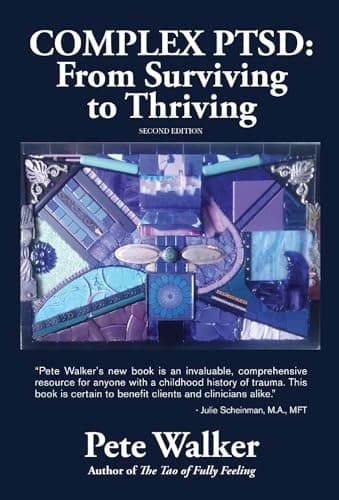
The Complex PTSD book by Pete Walker is not a casual read — it is a working manual for people who grew up in environments that taught them the world was not safe. If you have tried general self-help and it did not stick, this one might. The writing is warm, the framework is clear, and the 12-step emotional flashback protocol alone has helped thousands of readers manage what they previously thought was unmanageable. My rating: 4.3 out of 5.
What Is the Complex PTSD Book About?
First published in 2013, Complex PTSD: From Surviving to Thriving lands somewhere between memoir and clinical guide. Pete Walker draws on his own childhood experiences and two decades of therapy work to map out what he calls the "complex post-traumatic stress disorder" diagnosis — a condition recognised by the WHO in 2018 but still debated in diagnostic manuals like the DSM-5.
The core argument is straightforward: if your developmental years were dominated by emotional neglect, abuse, or caregivers who were unpredictable, frightening, or dissociated, your nervous system learned to survive in ways that no longer serve you as an adult. Walker breaks this down into four survival strategies — fighting, fleeing, freezing, and fawning — and argues these responses, once protective, become the core symptoms of CPTSD when they never get the chance to switch off.
Key Features
- 12-step emotional flashback management protocol — concrete, usable in real time
- Exploration of the four trauma responses and how they show up in daily adult life
- Reparenting techniques for working with the inner critic and wounded inner child
- Attachment theory foundation without academic jargon or dense citations
- Somatic awareness chapter on reading body signals during flashbacks
- Extensive case studies and Walker is not afraid to share his own failures
- Written for survivors, not clinicians — compassionate and accessible tone throughout
Hands-On Review
I picked this up after a rough stretch last autumn. I had finished a course of trauma-focused CBT and my therapist suggested something more long-form to work with between sessions. The Complex PTSD book sat on my nightstand for two weeks before I actually opened it — I was, honestly, a bit tired of reading about my problems. What changed my mind was a random Tuesday night when I could not sleep because an old trigger had surfaced unexpectedly.
Walker opens with the concept of emotional flashbacks — and the description stopped me cold. He describes them as time-travel experiences where a present-day trigger drops you back into the emotional state of the child you once were. Not a memory. A full, visceral re-experience. I had never seen that put into words so precisely. That was my first real engagement with the book.
What followed over the next month was uneven. The 12-step flashback protocol works. I tested it the third week — a work email sent me spiralling into a familiar shame-spiral that I would normally ride out for hours. I walked through the steps Walker outlines: identifying the flashback, saying the internally-directed phrases, grounding through the senses. It did not make the feeling disappear, but it gave me a handhold. Will I keep using it? Yes — though I will admit it took four or five rounds before it felt natural rather than like homework.
The chapters on the four trauma responses are where this book earns its reputation. Walker maps each response with real specificity — how fawn types lose themselves in relationships, how flight types become perfectionist workaholics, how freeze types dissociate into rumination, how fight types see threat in every neutral interaction. If you have ever wondered why you react the way you do in ways that seem disproportionate to the trigger, these chapters tend to hit home. The reparenting section is ambitious but sometimes feels like it wants to do therapy in your place. It does not quite manage that — but it gives you language and exercises that can supplement the real thing.
Who Should Buy It?
- Adult survivors of childhood emotional neglect or abuse who have a basic understanding that something is wrong but lack a framework to name it
- People who have tried general self-help books and found them too surface-level to address what is actually underneath their struggles
- Readers already in therapy who want a structured companion book to work with between sessions — Walker explicitly encourages this use
- Those who identify with CPTSD symptoms but have not found a diagnosis that fits — the book is validating without being clinical
Skip this one if you are currently in acute crisis or have a dissociative disorder that requires professional stabilisation first. The Complex PTSD book is not an emergency intervention — it is a recovery roadmap, and you need to be relatively stable to work through it effectively. If that is where you are right now, please reach out to a crisis service before picking this up.
Alternatives Worth Considering
- The Body Keeps the Score by Bessel van der Kolk — takes a more neuroscience-heavy, research-backed approach. Worth reading if you want the science alongside the story. Broader in scope but less immediately usable.
- Waking the Tiger by Peter Levine — focuses specifically on somatic approaches to trauma discharge. Gentler, more body-focused, and a good companion if Walker's psychological framing does not fully resonate with you.
- Running on Empty by Jonice Webb — specifically targets childhood emotional neglect with a more structured, workbook-style approach. Better if you want something shorter and more immediately actionable.
FAQ
CPTSD involves prolonged, repeated trauma — usually in childhood from neglectful or abusive caregivers. Unlike single-incident PTSD, CPTSD affects personality development and shows up as attachment difficulties, emotional dysregulation, and toxic shame alongside PTSD symptoms.
Final Verdict
The Complex PTSD book is not trying to be comprehensive — it is trying to be usable. And for the most part, it succeeds. The 12-step flashback protocol and the four-response framework are tools you can actually take into difficult moments, not just read and nod at. Walker's personal voice keeps it human throughout, and the absence of clinical distance makes it feel like a fellow traveller rather than an expert pronouncing from above.
It is not a substitute for therapy. It does not cite research in any formal way. And the reparenting chapters could have been half the length without losing their substance. But if you are someone who grew up in a household where your emotional needs were not met, and you have spent years wondering why standard self-help does not land, this one might. Check the current price on Amazon using the link below.