
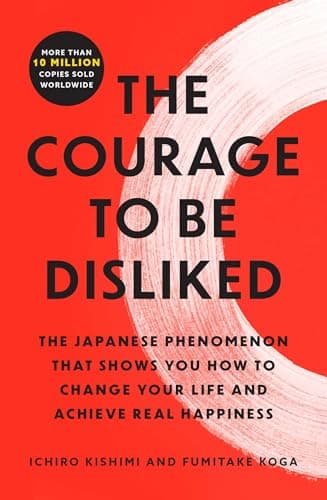
The Courage to Be Disliked Review – Does Adler's Philosophy Actually Work?
Quick Verdict
Pros
- Dialogue format makes complex psychology surprisingly accessible and easy to follow
- Challenges deeply ingrained approval-seeking habits with a fresh, logical approach
- Short enough to finish in a weekend but dense enough to warrant re-reading
- No pseudoscience or vague affirmations — roots everything in Adlerian theory
- Readable without any background in psychology
- The 'separation of tasks' concept alone is worth the price of admission
Cons
- Can feel repetitive if you're already familiar with Stoicism or CBT principles
- Some readers may find the philosopher's voice overly preachy at times
- The second half feels less focused than the first
- Doesn't offer concrete step-by-step exercises like many modern self-help titles
- Translation occasionally reads slightly stiff
Quick Verdict
I picked up The Courage to Be Disliked after a therapist friend handed it to me and said, "Read this before we talk about your people-pleasing." Two evenings later, I finished it and sat with that slightly uncomfortable feeling you get when a book actually lands. It's not magic, and it won't rewire your brain in a weekend. But if you've ever stayed in a bad situation because you were terrified of disappointing someone, or found yourself performing for approval in ways that left you exhausted, this slim Japanese bestseller has something useful to say. I'd give it a solid 4.3 out of 5 — especially if you're tired of self-help books that tell you to "just be positive" without explaining the mechanics.
What Is The Courage to Be Disliked?
First published in Japanese in 2013 and translated into English by Atria Books, this book presents the psychology of Alfred Adler through a Socratic dialogue between a gruff philosopher and a frustrated young man. No, it's not a textbook. There are no charts, no chapter summaries, no "action steps" printed in bold. Instead, you get roughly 280 pages of back-and-forth conversation that gradually unpacks how we sabotage ourselves by seeking validation, how we use past trauma as an excuse, and why "courage" — not confidence or talent — is the missing ingredient in most unhappy lives.
The authors, Ichiro Kishimi and Fumitake Koga, synthesized decades of Adlerian thought into something a general reader can absorb without a psychology degree. I found myself pausing constantly to argue with the philosopher in my head — which, honestly, is probably the point. By the time I finished the book's core argument, I was genuinely less sure of some habits I'd defended for years.
Key Features
- Dialogue-based format makes dense psychological theory feel conversational and personal
- Based on Alfred Adler's "individual psychology" — a coherent, evidence-adjacent framework
- Core concept: your unhappiness stems from lifestyle choices you can change right now
- Introduces the "separation of tasks" — a practical tool for setting interpersonal boundaries
- Challenges the "cause-and-effect" narrative that many therapists and self-help books reinforce
- Short enough to finish in a weekend but dense enough to justify slow reading
- Originally published in Japan; the English translation reads naturally for a Western audience
Hands-On Review
Let me be honest: I almost put this book down in the first thirty pages. The young man in the dialogue kept asking questions I found naive, and the philosopher's responses felt a bit too certain, a bit too clean. I was skeptical. By page fifty, though, something shifted. The philosopher started dismantling the idea that childhood experiences determine adult behavior, and I found myself getting genuinely defensive — which, of course, meant he was onto something.
What I appreciate most is that this isn't wishful thinking dressed up with anecdotes. Adler was a working psychologist, and his framework — that we choose our behaviors based on current goals, not past causes — has enough clinical grounding to feel credible even when it's uncomfortable. The book doesn't ask you to believe it on faith. It walks you through the logic until you either accept it or admit you're resisting for emotional reasons.
The "separation of tasks" concept was the biggest practical takeaway for me. The idea is deceptively simple: you handle your side of an interaction, and the other person handles theirs. If you apologize profusely for setting a boundary, you're actually stealing their task — deciding how they should feel about it. I've caught myself doing this dozens of times since reading it. Did I transform overnight? No. But I notice it now, which is further than most psychology books have gotten me.
Who Should Buy It?
- The chronic people-pleaser: If you say yes when you mean no, apologize for things that aren't your fault, or constantly adjust your behavior based on how you think others perceive you — this book was written for your exact pattern.
- The therapy-curious skeptic: You want substance, not just affirmations. You want to understand why you do what you do, not just be told to "heal."
- The overthinker: If you spend more time analyzing your past than acting in your present, Adler's goal-oriented framework offers a refreshing reframe.
- The reader who found Stoicism a bit cold: This has similar psychological boldness but warmer, more relational framing. It's less "harden yourself" and more "free yourself."
Skip this if you're looking for a structured program with worksheets and daily exercises. Skip this if you want quick-fix motivation tips. And skip this if you're deeply attached to the narrative that your childhood "made" you who you are — this book will feel like an attack, and honestly, that resistance might be exactly what you need to examine.
Alternatives Worth Considering
If The Courage to Be Disliked resonates with you but you want a different angle:
- The 48 Laws of Power (Robert Greene): For readers interested in the opposite approach — not letting go of control, but strategically wielding it. Very different philosophy, very different tone.
- Man's Search for Meaning (Viktor Frankl): Both Frankl and Adler emphasize that meaning is a choice, not a discovery. Frankl's account is more personal and harrowing; this book is more intellectual.
- Attached (Amir Levine): If you want to apply psychological principles specifically to romantic relationships with more modern attachment theory backing.
FAQ
It's a dialogue-based book that presents Alfred Adler's individual psychology through a conversation between a philosopher and a young man. The core idea is that you can change your life right now — not through past trauma or external circumstances — but by changing your own mindset and letting go of the need for others' approval.
Final Verdict
The Courage to Be Disliked isn't trying to be the last personal development book you ever read. It's trying to plant a single, uncomfortable seed: that the obstacles you blame for your unhappiness are, at least partly, ones you've chosen — and can therefore unchoose. Whether you find that liberating or threatening probably tells you something about yourself worth knowing. I'd recommend it to anyone who's done the usual self-help circuit and is ready for something with actual psychological teeth. It's not a perfect book — the second half drags, and the dialogue format isn't for everyone. But on balance, it earns its spot on the shelf. If you're ready to feel a little uncomfortable on your way to something better, pick it up.