
Crucial Conversations 3rd Edition Review – Is It Worth Your Time?
Quick Verdict
Pros
- The START method gives a clear, repeatable framework you can use on the spot
- Grounded in 25+ years of research and real organizational data, not just theory
- The third edition adds fresh examples and stronger emphasis on psychological safety
- Works equally well for workplace conflicts and personal relationships
- The accompanying training tools (workbook, videos) reinforce the book effectively
Cons
- Some concepts feel repetitive if you've read the first two editions
- At 300+ pages, it could be tighter —精华 is buried in places
- The corporate examples skew heavily toward American business culture
- Doesn't address conversations through text or video chat specifically
Quick Verdict
The Crucial Conversations book is one of the most evidence-backed communication guides I've encountered. It won't fix every relationship or eliminate every office showdown, but the START framework gave me a language for conversations I'd been avoiding for years. Score: 4.5/5. Buy it if you regularly navigate emotionally charged discussions — at work or at home.
What Is the Crucial Conversations Book?
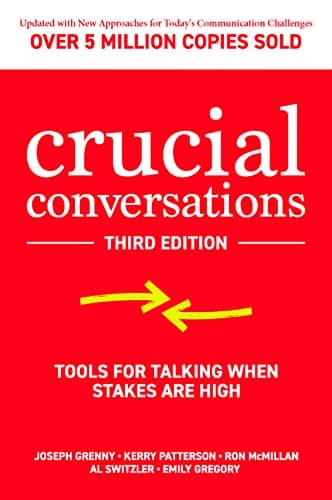
I first picked up Crucial Conversations on a Tuesday morning after a project meeting went sideways in about twelve seconds flat. Someone I respected called me out in front of the team, I froze, and by the time I got back to my desk I was replaying a dozen things I should have said. That night, I ordered the third edition. I wasn't looking for motivation — I needed a system.
Published by McGraw-Hill and updated in 2021, this is the third iteration of a book first released in 2002. The authors — Kerry Patterson, Joseph Grenny, Ron McMillan, and Al Switzler — spent over two decades studying why some people can talk about anything without burning bridges, while the rest of us either blow up or go silent. Their answer is what they call a crucial conversation: a discussion where stakes are high, opinions differ, and emotions run hot. The book is essentially a field manual for those moments.
Key Features
- The START framework: a five-step dialogue tool usable in real time during a tense conversation
- Focus on psychological safety — how to keep both parties willing to stay in dialogue
- Distinction between clean and dirty stories, and how to catch your own
- Action plans that move a group from dialogue to committed results
- New third-edition material on Change Management and contemporary workplace dynamics
- Backed by research across 300,000+ participants in more than 300 organizations
- Companion training resources including workbooks, videos, and facilitation kits
Hands-On Review
The core insight is deceptively simple: before you open your mouth, ask yourself what you actually want. Not the outcome you think you want — the deeper want. Do you want to win? To be right? Or do you want to solve the problem and preserve the relationship? Most of us confuse these two, especially in the moment. Crucial Conversations names that fog and gives you a way to cut through it.
I tested the START method the following Thursday in a one-on-one with a colleague who'd been missing deadlines that affected my work. I didn't script it; I just anchored to the first step — Start with heart — and reminded myself that I wanted a reliable partner, not a fight. I shared a specific fact (the missed handoff on Tuesday), told my short story without accusation, and then genuinely asked what was going on on their end. The conversation shifted. I'd been expecting defensiveness; instead, I got context I didn't have.
What's less glamorous but equally useful is the book's breakdown of silence and violence as escape routes from crucial conversations. I recognized myself in the silence patterns immediately — the way I'd been quietly avoiding certain colleagues rather than risk an uncomfortable exchange. The book doesn't moralize about this. It just points out that these are survival instincts that worked in the short term but cost you the relationship or the outcome you wanted.
The third edition adds a stronger thread around psychological safety — the organizational concept popularized by Amy Edmondson — which I thought strengthened the book's credibility. It also includes a new chapter on moving from dialogue to collective action, which is genuinely useful for managers and team leads. If you're a trainer or facilitator, the third edition is worth the upgrade. If you're a general reader coming to this for the first time, the core content is all there.
Who Should Buy It?
- Managers and team leads who mediate conflicts or deliver hard feedback regularly
- Anyone avoiding a specific conversation — salary, promotion, boundary-setting, ending a relationship
- HR professionals and coaches who need a structured framework to teach others
- People who tend to go silent or explode and want a middle path that doesn't require years of therapy
- Skip this if you want a quick motivational read — this is a skill-building book that rewards practice, not passive reading
Alternatives Worth Considering
- Nonviolent Communication by Marshall Rosenberg — goes deeper on empathy-first language and is more philosophically grounded. Heavier on personal relationships, lighter on workplace applications.
- Difficult Conversations by Stone, Patton & Heen (Harvard Negotiation Project) — excellent companion to Crucial Conversations with a complementary framework around three conversations: What Happened, Feelings, and Identity. More academic tone.
- The Power of Habit by Charles Duhigg — if your goal is changing behavior at scale in an organization, Duhigg gives you the broader systems lens that Crucial Conversations doesn't.
FAQ
The book teaches the START method: Start with heart (clarify what you really want), Tell your path (share your facts and story), Ask for their path (invite them to share theirs), Talk tentatively (speak with humility), and Test others' paths (verify, don't add). This five-step process helps keep dialogue safe even when emotions run high.
Final Verdict
I've read a lot of business books that feel like extended blog posts with a publisher. Crucial Conversations is different — it's a training manual that happens to be readable as a book. The START method isn't revolutionary in concept, but the specificity of the tool is what makes it stick. I used it within days of reading it, and I've used it again since. That's the test, really: does the framework survive contact with an actual high-stakes conversation? For me, it has. If you're regularly in situations where the wrong word at the wrong moment costs you something real — a deal, a relationship, your credibility — this book earns its place on your shelf.