
Don't Believe Everything You Think Review – Worth the Hype?
Quick Verdict
Pros
- Concise yet deeply impactful – every chapter feels essential
- Written in an accessible, conversational tone anyone can grasp
- Addresses the root cause of suffering rather than just symptoms
- Promotes genuine self-compassion and acceptance
- Short enough to finish in one sitting, dense enough to revisit for years
- No gimmicks or fluff – just honest, practical wisdom
Cons
- Very brief at under 150 pages – some readers may want more depth
- Minimal concrete exercises or actionable steps
- Approach is spiritual/philosophical rather than clinical
- Some concepts may feel abstract for readers needing structured guidance
- Not a replacement for professional mental health support when needed
Quick Verdict
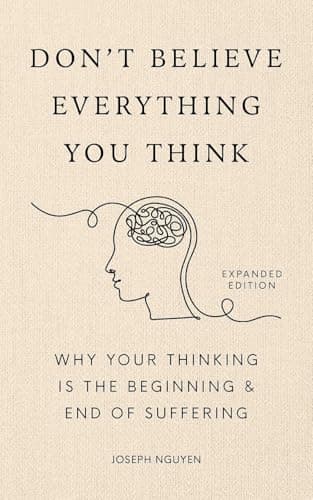
The first time I picked up Don't Believe Everything You Think, I expected another generic self-help book promising quick fixes. I was wrong. Joseph Nguyen's slim volume punched well above its weight, delivering a core message so simple it almost felt obvious — and yet somehow revolutionary in its application. If you've ever been trapped in anxious spirals, replayed embarrassing moments at 3 AM, or wondered why you can't just stop thinking, this book speaks directly to that frustration. My rating: 4.3 out of 5 — it earns high marks for impact and accessibility, though the brevity left me wanting more concrete exercises.
What Is Don't Believe Everything You Think?
The title basically gives away the premise: we suffer not because of what happens to us, but because we believe the thoughts our minds generate about those events. Nguyen walks readers through this realization with surprising gentleness — there's no judgment, no guilt trip, just a quiet invitation to observe your thinking from a slight distance. It's like noticing you're watching a movie rather than being consumed by it.
At its heart, the book argues that every thought we accept as truth creates emotional residue. That critical inner voice? It's not you — it's just neural chatter your brain generates automatically. The freedom comes not from controlling thoughts, but from not believing everything you think. Nguyen frames this not as a technique but as a recognition of what's already true.
Key Features
- Concise 140-page format ideal for busy readers
- Conversational, non-academic writing style
- Explores the thought-suffering connection without jargon
- Emphasizes self-compassion over self-criticism
- Part of a planned "Beyond Suffering" book series
- Suitable for both spiritual and secular audiences
- Audiobook narration praised for its calm, measured delivery
Hands-On Review
I won't pretend I read this book in one dramatic session. It sat on my nightstand for a week before I actually sat down with it properly. But once I did, I found myself reading entire chapters in a single sitting — not because it's page-turning thriller material, but because the ideas genuinely land. Chapter six in particular stopped me cold. Nguyen describes the moment he realized his fear of judgment from others was just... a thought. Not a fact. Just noise. I put the book down and stared at my ceiling for five minutes, turning that over.
What surprised me was how the book's simplicity actually works against it in one way. I kept waiting for the catch — some complex framework, some 12-step process. Instead, it's just repeated emphasis on the same core insight: notice, don't engage. Accept, don't believe. I almost wanted more structure to sink my teeth into. But that's probably a me problem rather than a book problem.
The writing has an almost lyrical quality that I didn't expect. Nguyen clearly spent time crafting each short chapter rather than padding for page count. This makes it perfect for re-reading specific sections during stressful weeks. I dog-eared pages 43, 78, and 112 — three different angles on the same fundamental idea, each one landing slightly differently depending on what I was going through.
Who Should Buy It?
Honestly? Most people would find something useful here. But the book shines brightest for:
- Anxious overthinkers who feel stuck in mental loops they can't escape
- Mindfulness beginners who want a gentle introduction before tackling denser texts
- Skeptics of self-help who want substance without pseudoscience
- People in therapy looking to complement their work with philosophical depth
Skip this one if you need structured exercises or worksheets — there are essentially none here. It's philosophy and insight, not a workbook. Also skip it if you're looking for scientific citations or clinical frameworks; Nguyen offers wisdom, not data.
Alternatives Worth Considering
If you're comparing options in this space:
- The Power of Now by Eckhart Tolle — shares the spiritual mindfulness DNA but goes deeper into consciousness exploration; better if you want a more comprehensive spiritual framework
- Mind Over Mood by Dennis Greenberger — if you need something more structured with concrete CBT techniques and worksheets; less philosophical, more practical
- The Untethered Soul by Michael Singer — another slim spiritual wisdom book; Singer takes a slightly more mystical angle while Nguyen stays more grounded in everyday thought patterns
FAQ
The book explores how our suffering stems from believing our thoughts rather than observing them. Joseph Nguyen argues that by recognizing thoughts as temporary mental events—not absolute truths—we can naturally release anxiety, self-doubt, and emotional pain.
Final Verdict
Don't Believe Everything You Think isn't trying to be everything to everyone — and that's exactly why it works. At under 150 pages, Joseph Nguyen delivers a focused, genuinely useful insight: your thoughts are not facts, and suffering Optional. Whether you're deep in anxious spirals or simply curious about the nature of your own mind, this book offers a quiet perspective shift that compounds over time. It's not a magic wand, but it's a solid foundation worth building on. Check current price on Amazon and decide for yourself.