
Expecting Better by Emily Oster Review – A Data-Driven Pregnancy Guide
Quick Verdict
Pros
- Breaks down complex medical research into plain language anyone can act on
- Gives parents a decision-making framework instead of just a list of rules
- Covers the full pregnancy arc – from conception through delivery
- Honest about what the data does and doesn't prove
- Written by an economist, not a doctor – a genuinely fresh angle
Cons
- Can feel clinical at times; lacks the warmth of more narrative-driven pregnancy books
- Some recommendations contradict your doctor's advice – and Oster doesn't always make that tension explicit
- The food safety sections may raise anxiety rather than relieve it for some readers
Quick Verdict
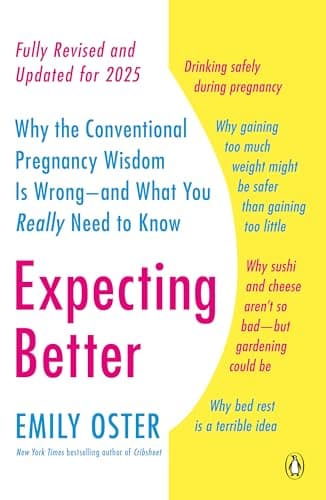
Expecting Better by Emily Oster isn't a warm-and-fuzzy reassurance book – it's an economist's field report on pregnancy advice. Oster takes the rules you've heard a thousand times (no wine, no sushi, no coffee, induced by 40 weeks) and drags them into the light to see which ones hold up under actual data scrutiny. Most don't. That sounds stressful, but the payoff is a sense of control that generic prenatal advice simply can't offer. If you want to understand why you're being told certain things and make choices that fit your own risk tolerance, this book earns its place on your nightstand. If you prefer your pregnancy guidance simple and declarative, give this one a pass. Check the current price on Amazon.
What Is the Expecting Better Book About?
Expecting Better arrived in 2013 and quickly became the pregnancy book that pregnant women handed to their partners before handing over any other title. Oster, a professor of economics at Brown University, didn't set out to write a health book – she started digging into the research because she was pregnant, annoyed at vague pronouncements, and constitutionally incapable of accepting 'because I said so' as an answer.
What she found, broadly, is this: a huge portion of standard pregnancy advice isn't rooted in strong science. The fear around occasional alcohol, the zero-caffeine drift, the blanket sushi ban – many of these rules were adopted as conservative defaults rather than conclusions drawn from rigorous studies of actual harm. Oster's book walks through the research, shows you the numbers, and hands you a framework for weighing them yourself.
Key Features
- Economist's lens applied to 50+ common pregnancy rules and medical recommendations
- Full pregnancy journey covered: first trimester through delivery and induction
- Data presented in plain English with study limitations clearly noted
- Decision-making framework for parents who want to assess risk independently
- Chapter on interpreting medical studies – useful skill beyond pregnancy
- Includes a practical guide to food safety with real bacterial risk data
- Expanded and updated edition reflecting newer research and reader questions
Hands-On Review
I picked this up during my second pregnancy, partly because the first round of advice-giving had left me vaguely resentful and mostly confused. 'Don't eat this.' 'Actually, you can eat that.' 'One coffee is fine.' 'No, zero caffeine.' My OB's office wasn't being careless – they were being cautious, which is reasonable. But caution without context felt like being handed a map with all the roads removed.
Expecting Better gave me the roads back. The alcohol chapter is the most talked-about, and it deserves that attention – not because Oster tells you to drink (she doesn't), but because she shows you the actual relative risk data and lets you land somewhere informed rather than guilty. After reading it, I felt less anxiety about the half-glass of wine I had at a friend's wedding at 28 weeks, and more importantly, I understood why that decision sat within a reasonable range for me.
What surprised me was the labour and delivery section. I expected the book to be strongest on first-trimester lifestyle rules – that's where the cultural anxiety concentrates. And it is strong there. But the chapters on induction timing, C-section rates, and how to evaluate your doctor's preferred intervention timeline were, honestly, more practically useful by week 36. Oster doesn't tell you what to choose, but she arms you with enough context to have a genuinely informed conversation with your provider rather than just saying yes by default.
The book's one real weakness is tone. Oster is rigorous and precise, which is the whole point, but it can make for a somewhat clinical read. There are no birth stories, no softening anecdotes, no 'I cried in a grocery store at week 22' moments. For a reader like me, that was a feature. For a reader who wants a more emotionally warm companion through pregnancy, it might be a bug.
Who Should Buy It?
This book is for you if any of the following sound familiar:
- You've been handed a list of pregnancy 'don'ts' and quietly wondered where the evidence actually is
- You prefer making decisions based on data rather than cultural defaults
- You're a second-time parent who felt the first pregnancy was ruled by fear rather than information
- You're planning to advocate for yourself in a hospital setting and want a framework for evaluating interventions
- You like the idea of ParentData and want to start at the beginning of Oster's evidence-based parenting project
Skip this if you want a comforting, reassuring read that tells you everything is probably fine. Expecting Better is honest in ways that can initially feel alarming. And if you're the kind of reader who finds data-driven analysis stressful rather than empowering, a gentler guide may suit you better during pregnancy.
Alternatives Worth Considering
If Expecting Better sounds right in principle but the clinical tone gives you pause, consider these alternatives:
What to Expect When You're Expecting by Heidi Murkoff remains the mainstream standard. It's warmer, more reassuring, and organised week by week – better as a general companion, though less critical in its analysis.
The Fourth Trimester by Kimberly Ann Johnson focuses on the postpartum period and physical recovery rather than pregnancy itself. A natural follow-up read once you've finished Oster.
Cribsheet by Emily Oster is her follow-up covering the first year of parenting with the same data-driven approach. If you finish Expecting Better and appreciate her style, Cribsheet is the logical next step.
FAQ
Oster cites peer-reviewed studies throughout and is transparent about study limitations. Her core argument – that many standard pregnancy rules lack strong evidence – is well-supported. However, she's an economist, not an OB-GYN, so readers should always consult their healthcare provider for personalised medical advice.
Final Verdict
Expecting Better isn't trying to replace your OB or midwife – it's trying to make you a more informed patient. Emily Oster doesn't soften her conclusions, but she does contextualise them, and that context is what most pregnant people are actually hungry for. The book won't tell you what to eat, whether to induce, or how to feel about your choices. What it will do is make you feel like the decisions are yours to make, backed by something more solid than superstition dressed up as health advice.
Is it the right pregnancy book for everyone? No. But for the reader who has ever thought 'wait, why exactly?' – it's one of the most useful things you can read before your due date.