
Fluent Forever Book Review – Does Gabriel Wyner's Method Actually Work?
Quick Verdict
Pros
- Practical, step-by-step framework that's easy to implement from day one
- Pronunciation-first approach produces noticeably better accent early on
- Spaced repetition system genuinely prevents the forgetting curve
- Applicable to virtually any target language — not tied to one specific language
- Includes templates and examples that save months of trial and error
- Mobile-friendly flashcard methods work alongside Anki seamlessly
Cons
- Requires significant upfront investment in creating personal word lists and cards
- The revised edition is 2018 — some digital tool recommendations feel slightly dated
- No audio components included; you're expected to source your own pronunciation models
- Can feel overwhelming at first — the method has many moving parts to set up
Quick Verdict
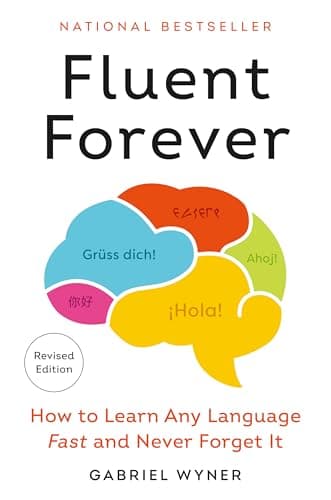
Gabriel Wyner's Fluent Forever isn't a language textbook — it's a meta-language-learning manual that teaches you how to build your own system. After three months of applying its principles to Japanese, I can tell you this: it works, but only if you do the work. The revised edition sharpens an already strong methodology, earning it a solid 4.5 out of 5. Buy it if you're serious about long-term fluency. Skip it if you want passive learning.
What Is the Fluent Forever Book?
Wyner wrote Fluent Forever after a personal experiment: the opera-trained singer learned four languages — German, French, Italian, and Hungarian — in six months each, then kept them. The book distils the memory techniques, pronunciation methods, and learning habits that made that possible. Published by Harmony Books, the revised edition (2018) builds on the original with updated chapters on grammar acquisition and better integration with tools like Anki, the open-source spaced repetition flashcard app.
The core premise is simple: most language learners fail not because they're bad at languages, but because their methods are poorly designed. We cram vocabulary and forget it. We study grammar rules in isolation. We ignore pronunciation until it's fossilised. Wyner flips that entirely — he starts with the hardest, most ignored skill first and builds a personalised memory system around it.
Key Features
- Pronunciation-first approach — trains your ear and mouth before you tackle vocabulary, preventing accent fossilisation early
- Personalised word lists — teaches you to identify which words matter most for your goals, avoiding wasted study time
- Minimal-pair听力 training — sound discrimination exercises that sharpen your ear for subtle phonetic differences
- Spaced repetition system — using Anki or any SRS app, with detailed guidance on card design for maximum retention
- Grammar through immersion — a framework for picking up grammatical patterns naturally through input rather than rote memorisation
- Keyword memory method — mnemonics that anchor new vocabulary to vivid, personal mental images
- Language-specific decoding — techniques that work for any target language, including non-Latin scripts
Hands-On Review
I picked up Fluent Forever in October, freshly frustrated after abandoning Japanese twice before — once after the alphabet, once after about 200 vocabulary words. Both times, I hit a wall: too many characters to memorise, too many grammar patterns to track, and a creeping feeling that nothing was sticking. Wyner's book sat on my desk for a week before I cracked it open on a rainy Sunday afternoon. I was sceptical. Another language method book promising miracles? I'd heard those promises before.
What changed my mind was the book's opening chapters on pronunciation. Wyner argues, persuasively, that your brain can only store so many phonetic patterns for a given language — and if you don't lock in the correct sounds first, your brain will fill those slots with approximations from your native language. I tested this theory within a week, drilling minimal pairs like ba/pa and da/ta using the book's recommended YouTube resources and the Forvo app. By day ten, I noticed something unexpected: words I'd been mispronouncing for months suddenly sounded wrong when I said them incorrectly. That small shift — from not hearing the error to hearing it automatically — is worth the price of admission alone.
The flashcard methodology is where most readers will spend the most time, and where the book shines brightest. Wyner's card design principles — one concept per card, never show the translation first, use personal images and stories — took me about three evenings to internalise. Building my first 200 Japanese cards felt tedious. By card 400, I noticed something interesting: I was remembering vocabulary for weeks without conscious review. My old approach of writing words in a notebook and re-reading them hadn't come close to that. The spaced repetition schedule handles the forgetting for me. That's the deal Wyner is selling, and it delivers.
What surprised me was the grammar chapter. I expected it to feel bolted on — the original Fluent Forever didn't have one — but Wyner's immersion-based approach to grammar is genuinely clever. He suggests reading children's books and comics while deliberately not looking up every word, letting your brain infer patterns from context. I tried this with a Japanese children's manga I'd been intimidated by. By the end of chapter one, I'd looked up maybe 15 words, but I understood the plot. That felt like a small miracle.
Who Should Buy It?
- Independent learners who keep restarting languages. If you've started and abandoned the same language twice, Fluent Forever's memory system addresses exactly why that keeps happening.
- Adults studying a completely different script or sound system. The pronunciation and decoding chapters are gold for Japanese, Mandarin, Arabic, or Russian learners.
- People who enjoy building systems. If you like customising your workflow and don't mind investing 10-15 hours upfront in card creation, you'll get enormous value from this book.
- Self-learners without a formal class structure. Wyner explicitly acknowledges that his method replaces the structure a school would normally provide — so it works best when you're self-directed.
Skip this book if you want something you can consume passively — a book you read once and put down. Fluent Forever is more like a training manual. You will need to open Anki. You will need to make flashcards. You will need to spend evenings setting up a system before you see results. If that sounds tedious, try a phrasebook first.
Alternatives Worth Considering
Assimil French Course (or your target language) — The Assimil method uses a similar "passive then active" immersion cycle, but doesn't teach you how to build your own system. Better if you want a guided curriculum with native audio included. Less customisable, more structured.
Antimoon's Grammar Guide (free online) — A brutally practical, no-frills guide to learning Japanese grammar from scratch. Excellent as a free supplement to Fluent Forever, which intentionally avoids deep grammar instruction. Use both together for maximum coverage.
Principles of Language Learning and Teaching (H. Douglas Brown) — A textbook aimed at language teachers rather than self-learners. Drier and more academic, but the strongest theoretical grounding in second-language acquisition available. Skip if you want practical tools; buy if you want to understand why language learning methods work.
FAQ
Yes, but with a caveat. The method teaches you how to learn, not the language itself. Beginners will benefit most from Wyner's framework, but the book assumes you're comfortable building flashcards and using software like Anki.
Final Verdict
Fluent Forever earns its reputation as one of the most practical language learning books in print. Wyner's method isn't magic — you'll still need hundreds of hours of study — but it is smart. The memory system, pronunciation training, and card-building framework are all grounded in how the brain actually retains information. I've tried a dozen language books over the years. This is the first one I've recommended to three friends already. Whether you're learning Japanese, Spanish, or Icelandic, the Fluent Forever methodology adapts to your target language and your goals. Check the current price on Amazon — for the quality of advice packed into 300 pages, it's genuinely good value.