I'm Glad My Mom Died Review – Honest Take on McCurdy's Memoir
Quick Verdict
Pros
- Brutally honest self-assessment that avoids the typical celebrity-memoir vanity trap
- Grounds mental health struggles in sensory, specific detail rather than clinical abstraction
- Short enough to read in one sitting — no padding or filler chapters
- The eating disorder section is one of the most frank depictions in popular memoir
- Dark humor woven through heavy passages keeps it readable rather than exhausting
- Accessible as both ebook and audiobook
Cons
- Subject matter is genuinely heavy — not a casual read
- Detailed descriptions of restrictive eating may be triggering for some readers
- McCurdy's youth (she wrote it at 31) occasionally shows in the analytical voice
- The later chapters feel slightly less urgent than the first half
- Doesn't fully unpack her career on Nickelodeon or name specific collaborators
Quick Verdict
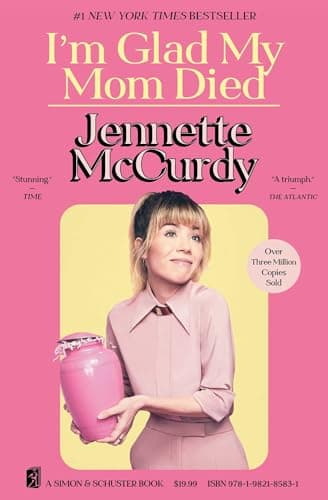
The first time I picked up I'm Glad My Mom Died, I put it down after two pages. Not because it was bad — because it hit too close to something. I came back a week later, and Jennette McCurdy pulled me through the entire thing in a single Saturday. This isn't a celebrity memoir in the vein of breezy Hollywood tell-alls. It's a book about control, shame, and the long shadow a parent can cast on a child's relationship with food, her body, and herself. I'm Glad My Mom Died earns its spot on the bestseller shelf — not because it's comfortable, but because it's honest in a way most books in this genre never attempt. Score: 4.3/5.
What Is I'm Glad My Mom Died?
Jennette McCurdy was a household name for a generation of kids who grew up watching her play Sam Puckett on Nickelodeon's iCarly and its spin-off Sam & Cat. She was also, by her own account, deeply miserable throughout her entire career — performing a version of herself that her mother had essentially engineered, right down from the audition tape to the food rules that governed their household. Her mother died of cancer in 2013, and McCurdy spiraled into a eating disorder that had actually begun in childhood.
The memoir traces that arc: a controlled, emotionally weaponized childhood, the trap of child stardom, the eating disorder that function as both a coping mechanism and a final act of rebellion, and the long, unglamorous process of untangling who she actually is beneath all of that. McCurdy writes in first person, past and present tense interwoven, and her voice is consistently self-aware without tipping into self-pity. By the end, she is calling herself out as clearly as she calls out her mother — which is what makes the book credible.
Key Features
- 320-page memoir published August 2022 by Simon & Schuster
- Available as hardcover, paperback, ebook, and audiobook narrated by McCurdy
- Structured chronologically with reflective commentary on past selves
- First-person account of emotional parentification and enmeshment
- Explicit, sensory depiction of a restrictive eating disorder from childhood into adulthood
- Dark humor threaded through genuinely dark subject matter
- No name-and-shame approach — focuses on McCurdy's internal experience rather than industry gossip
Hands-On Review
I'll admit something: I approached this book with low expectations. Celebrity memoirs have a reputation for being thin — emotionally and literally. The sample chapters from many actors and performers read like extended magazine profiles, carefully curated to protect a brand. McCurdy explicitly dismantles that pattern within the first three chapters, and it's what kept me reading.
What surprised me most was the specificity of the eating disorder section. McCurdy doesn't describe her relationship with food in abstract psychological terms — she describes the smell of the specific protein bars her mother packed for her, the way she would count calories under a dressing room light, the exact texture of the food she binged and then purged. I expected that part to feel clinical. Instead it felt urgent, almost feverish, the way memory actually works when you're trying to explain something you couldn't control. I read that section in one sitting on a Tuesday morning and forgot to make coffee, which never happens.
The book's strongest section is the middle third, where McCurdy is most willing to implicate herself. She describes moments where she was cruel, where she manipulated situations to maintain her mother's attention, where she understood exactly what she was doing and did it anyway. That's not the portrait of a victim most celebrity memoirs settle for. It's the portrait of a person shaped by a system she didn't create and couldn't easily escape. That complexity is rare in this format.
There is a minor dip in the final third. Once McCurdy begins recovery and exits acting, the narrative loses some of its earlier tension. Recovery doesn't have the same dramatic arc as spiraling — and McCurdy is honest enough not to fake one. The book ends on a note of hard-won quiet rather than transformation. Which, honestly, feels more truthful than a redemption arc would have been.
Who Should Buy It?
This memoir lands for a specific readership, and it will feel irrelevant or uncomfortable for others:
- Readers who want celebrity memoirs that actually mean something. If you've read a dozen Hollywood books and found them shallow, this one is the exception.
- Adult children of emotionally controlling parents. McCurdy's language of enmeshment and parentification will feel painfully familiar, and her processing of grief-without-guilt is handled with care.
- People with lived experience of restrictive eating disorders. The sensory detail is vivid. Know that before you start — it's not written to shock, but it doesn't soften either.
- Anyone interested in how childhood stardom shapes identity. McCurdy is reflective without being self-congratulatory about her career decisions.
Skip this if you want a breezy Hollywood read, or if you're in active recovery from an eating disorder and working with a clinician who advises caution with detailed diet content. This book asks something of you. It's okay to decide you're not in a place to give it.
Alternatives Worth Considering
- First Lady of Double Tree by Hilton — different format, but for readers who want more celebrity memoir depth without the eating disorder content, this is a solid alternative in the same space.
- Hunger by Roxane Gay — if you're drawn to this book primarily for the eating disorder memoir aspect, Roxane Gay's Hunger is a more extended, equally honest examination of weight, shame, and the body, written in a different voice and context.
- Finding Me by Viola Davis — for readers who want the emotional depth and childhood adversity angle without the eating disorder specificity, Davis's memoir offers a different but equally powerful portrait of a performer shaped by early adversity.
FAQ
It's Jennette McCurdy's memoir about growing up as a child actress under the control of her emotionally abusive mother, and her subsequent struggle with an eating disorder that lasted into her late twenties. The title reflects her complicated grief after her mother's death from cancer.
Final Verdict
I'm Glad My Mom Died is the rare celebrity memoir that earns its emotional weight through restraint rather than excess. McCurdy resists the urge to name villains and heroes — her mother is humanized, not demonized, and McCurdy herself is held to account without being diminished. The eating disorder sections are not for everyone, but for readers who can hold them, they offer one of the most honest depictions of restrictive thinking in popular nonfiction. It's not a comfortable book, and it doesn't want to be. Whether you find that refreshing or exhausting will depend entirely on where you're meeting it from. For me, it landed somewhere I didn't expect: I put it down feeling like I'd read something true.