
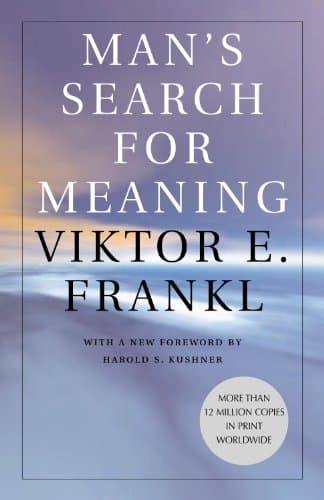
Man's Search for Meaning Review: A Raw, Honest Verdict
Quick Verdict
Pros
- Frankl's personal account of surviving concentration camps is raw, honest, and unforgettable
- Introduces logotherapy—a practical framework for finding meaning even in suffering
- Short enough to finish in a few sittings but dense enough to reread for years
- Written with restraint—no melodrama, just precise psychological observation
- The central idea (choose your attitude toward suffering) has genuine, lasting application
- Influenced generations of psychologists, therapists, and readers seeking purpose
Cons
- The philosophical Part Two is denser than the memoir and requires more patience
- No concrete "how-to" steps—it gives you a mindset, not a checklist
- The subject matter is harrowing; not a book for light reading
- Some readers expect pop-psychology motivation and will find this too austere
Quick Verdict
Man's Search for Meaning by Viktor E. Frankl is a short, devastating Holocaust memoir fused with a therapeutic philosophy that argues meaning—not pleasure or power—is what keeps us human. Frankl survived Auschwitz by discovering that those who found a why could endure almost any how. I've read it twice now, and both times it unsettled me in ways I didn't expect. If you're looking for comfortable self-help, look elsewhere. If you want a book that earns its weight in gold through sheer honesty, this is it. Score: 4.5/5.
What Is Man's Search for Meaning?
First published in German in 1946 and translated into English by Ilse Lasch in 1959, Man's Search for Meaning is technically two books stitched together. The first half is Frankl's personal account as a psychiatrist imprisoned in Theresienstadt and Auschwitz. The second half introduces his psychological method—logotherapy—without the usual academic padding. Published by Beacon Press, it has sold more than 16 million copies and is routinely listed among the most influential books of the 20th century.
The core argument is stark: between stimulus and response, there is a space. In that space lies our freedom to choose our attitude. Frankl didn't arrive at this conclusion through armchair philosophy—he arrived at it watching men die in striped uniforms, deciding in real time whether meaning was possible or merely a comforting illusion.
Key Features
- Part One: raw, eyewitness account of Holocaust concentration camp psychology and survival
- Part Two: logotherapy theory—meaning as the primary human motivation
- Three sources of meaning: purposeful work, love for others, and attitude toward suffering
- Written with clinical precision—no melodrama, no self-pity, just observation
- Short format (under 200 pages) makes it accessible to almost any adult reader
- Influenced psychology, psychiatry, pastoral counseling, and popular self-help
- Author held a PhD in medicine and neurology alongside his psychological training
Hands-On Review
I picked up my copy from a used bookstore on a rainy Thursday, expecting something dry and academic. The opening chapters disabused me of that quickly. Frankl writes with the detachment of a clinician who was also a victim, and that tension is what makes the book difficult to put down. He describes the moment prisoners were stripped, searched, and herded into the camp—and what he noticed wasn't just fear. It was the particular silence that comes when a man has just watched everything he owns scattered on a concrete floor.
By day three I noticed something shift in Frankl's narration: the prisoners weren't just enduring. They were developing their own micro-cultures. Some found meaning in hoarding a scrap of paper. Others kept themselves sane by imagining their unfinished manuscripts, the lectures they'd never give, the families they might still see. Frankl describes a fellow prisoner who, upon learning he would be transferred to a camp with better odds, hallucinated seeing spring sunshine—because he'd been thinking of his wife. That image stuck with me long after I closed the book.
The second half is where things get more cerebral. Logotherapy isn't a self-help checklist; it's a framework. Frankl argues that neurosis often stems from an existential vacuum—a void left when purpose disappears. His therapy helps patients find meaning through three avenues: what we create (work), what we experience (love), and how we face unavoidable suffering. It's a clean idea, and you can see why it resonated so broadly.
What surprised me was how the book's ideas aged. Frankl wrote this before positive psychology, before purpose-driven-performance research, before the WHO started measuring wellbeing. Yet the data now supports his intuition. Having a sense of meaning predicts health outcomes, longevity, and resilience better than income or social status. Frankl didn't have the studies. He had the camps—and that turns out to be enough.
Who Should Buy It?
- Readers facing loss, grief, or a major life crisis—Frankl's framework offers something harder to find than motivation: a way to metabolize suffering rather than escape it
- Psychology and philosophy students—this is foundational 20th-century thought with direct influence on counseling and psychiatry
- Anyone who found Viktor Frankl's TED Talk or quotes online and wants the full picture—you'll understand why the ideas hit differently in context
- Readers interested in Holocaust literature—Frankl's clinical eye captures aspects of camp life that more literary memoirs miss
- Skip this if you want practical, step-by-step personal development with exercises and action plans. Man's Search for Meaning is a mindset shift, not a workbook
Alternatives Worth Considering
If Man's Search for Meaning resonates, here are two directions worth exploring:
- Man's Search for Ultimate Meaning (also Frankl, published 2004) — a later, shorter work that explores the spiritual dimensions of meaning he only hinted at in the original. Good if you want more depth on the religious side.
- When Nietzsche Wept by Irvin D. Yalom — a novelized but well-researched exploration of existential psychology that covers Freudian psychology, Breuer, and the birth of talk therapy. More narrative, easier to read in one sitting.
FAQ
It is Viktor Frankl's account of his experiences in Nazi concentration camps combined with his therapeutic method called logotherapy. Frankl argues that the primary human drive is not pleasure (Freud) or power (Adler) but meaning—and that finding meaning, even in suffering, is what sustains us.
Final Verdict
Man's Search for Meaning is not a comfortable book, and Frankl never intended it to be. It asks something of you: that you sit with hard ideas about suffering rather than flinching toward easy answers. The concentration camp sections are harrowing, the logotherapy theory is occasionally dense, and there are no guaranteed happy endings in the text. What Frankl offers instead is harder to fake—evidence that human beings can choose their response to almost anything, and that meaning is available even in the worst possible circumstances. It's a slim book with a weight far beyond its page count. Read it, let it sit for a week, then read it again.