
Never Split the Difference Review – Negotiate Like an FBI Hostage Negotiator
Quick Verdict
Pros
- Tactical empathy framework is immediately applicable to real conversations
- FBI case stories make abstract concepts stick
- Calibrated questions genuinely shift power dynamics in your favor
- Covers both high-stakes and everyday negotiation scenarios
- Concise — you can finish it in a week of evening reading
Cons
- Some examples involve situations most readers will never face (terrorists, kidnapping)
- Can feel repetitive if you've read other negotiation titles
- Lacks step-by-step exercises for drilling techniques
Quick Verdict
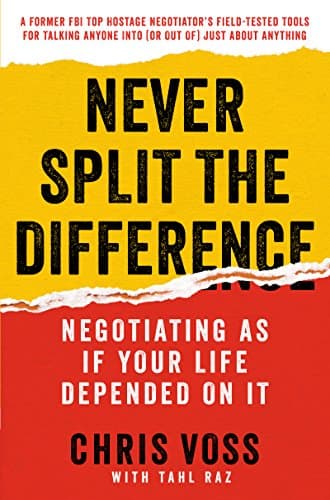
If you want a Never Split the Difference review that skips the fluff: Chris Voss delivers one of the most practical negotiation books I've encountered. It cuts through theory and puts you inside real FBI standoffs, then translates those lessons into salary talks and vendor calls. Rating: 4.6/5.
What Is Never Split the Difference?
I admit it — I almost shelved this one after the first chapter. The opening scene involves a bank robbery hostage situation, and I figured the whole book would be too dramatic to apply to my actual life: spreadsheets, recruiter emails, and the occasional contractor quote. I was wrong. Within two chapters, Voss had already reframed how I think about every conversation that has a stakes element to it.
Chris Voss spent 24 years with the FBI, most of it as a lead international hostage negotiator. After retiring, he founded The Black Swan Group and started teaching these same techniques to corporations and MBA programs. Never Split the Difference (2016) is his attempt to give everyday people the same toolkit he used to talk suicidal suspects off ledges and extract hostages from armed takeovers. The central argument: most people negotiate badly because they treat it like a debate to win, not a psychological exchange to understand.
Key Features
- Tactical empathy — understanding the other party's emotions and reflecting them back to build trust
- Mirroring technique — repeating key words to encourage the other party to elaborate and reveal more
- Calibrated questions — open-ended "how" and "what" questions that shift control of the conversation to you
- "No" as a tool — using "no-oriented" questions to give the other party permission to decline and feel safe
- Ackerman model for pricing — a structured offer system that prevents overpaying by 50% or more
- Black swans — overlooked pieces of information that, once discovered, swing negotiations entirely
- Real FBI case studies woven into every chapter for context and memory retention
Hands-On Review
After reading Never Split the Difference, I tried the mirroring technique in a client call I was dreading. The client's brief had shifted three times and I was already behind. Instead of pushing back, I mirrored the last thing she said — "So what you're saying is the timeline is really tight and the scope needs to shrink" — and she stopped, took a breath, and actually started problem-solving with me instead of against me. That one shift turned a confrontational call into a collaborative one. It wasn't magic. But it was immediate.
What I appreciate most is that Voss doesn't dress up his methods in jargon. He calls the "labeling" technique what it is: giving a name to the emotion you hear in someone's voice. He calls "tactical empathy" what it is: showing you understand why someone feels the way they do without agreeing with them. This matters because it means you can actually remember these under pressure, not just in a classroom exercise.
The FBI stories are genuinely gripping. The chapter where Voss talks a suicidal man down from a bridge — using the very mirroring and labeling techniques he teaches — makes the concepts unforgettable. But I'll admit: by chapter six, I was skimming some of the hostage scenarios because I kept thinking, "How does this help me negotiate a car lease?" The answer is usually buried in the last few paragraphs of each case study, and I wish Voss had pulled those insights forward more explicitly.
The Ackerman model alone is worth the price of the book if you've ever bought a car or negotiated a freelance rate. It's a systematic approach to making offers that starts high (but not insultingly so) and decreases in precise increments, never giving away more than necessary at each step. I've used a version of it twice since reading.
Who Should Buy It?
- Sales professionals and recruiters — the calibrated questions section alone could lift your close rate
- Managers handling difficult conversations — from performance reviews to contract renewals
- Freelancers and consultants who negotiate their own rates and scope changes
- Anyone who hates negotiating and wants a framework that makes it feel less like combat
- Skip this if you already have solid negotiation training and prefer academic, research-heavy frameworks — this book is tactical and story-driven, not data-driven
Alternatives Worth Considering
- Getting to Yes by Fisher, Ury, and Patton — the classic interest-based negotiation guide. Better for people who prefer structured principles over psychological tactics. Less engaging to read, but foundational.
- Influence: The Psychology of Persuasion by Robert Cialdini — broader scope covering six core persuasion principles. Great companion to Voss if you want to understand the underlying psychology.
- Negotiation Genius by Deepak Malhotra and Max Bazerman — more analytical and corporate-focused. Better suited for M&A, legal, or high-stakes business negotiations.
FAQ
It's a negotiation guide written by former FBI hostage negotiator Chris Voss. He distills years of high-pressure negotiation experience into tactics like tactical empathy, mirroring, and calibrated questions that work in salary talks, sales, and everyday disputes.
Final Verdict
Never Split the Difference earns its status as one of the most recommended business books of the last decade. Voss's FBI background gives it a credibility and drama that keeps you reading, but the real value is in how portable these techniques are. I've used tactical empathy in a vendor dispute, calibrated questions in a salary discussion, and mirroring in a tense family conversation. None of those situations looked anything like a hostage negotiation, but the underlying human psychology was identical. It's not a perfect book — the case studies can feel overlong, and some readers will want more structured exercises — but the core toolkit is sound, practical, and surprisingly easy to start using the same day you finish chapter three.