
Noise Book Review: A Deep Dive into Human Judgment Flaws
Quick Verdict
Pros
- Introduces a concept — noise — that even fans of Thinking, Fast and Slow likely missed
- Authors back claims with dozens of real-world case studies, from insurance underwriting to medical diagnosis
- Practical "Noise Audit" framework gives managers a concrete starting point
- Kahneman's signature clarity makes dense research genuinely readable
- Book works as a standalone even if you haven't read Nudge or Thinking, Fast and Slow
Cons
- Lack of a star rating in this listing means checking Amazon directly for current buyer sentiment
- Solutions to noise (hiring algorithms, decision audits) feel underdeveloped compared to the problem
- Three-author structure occasionally shows: some chapters repeat earlier points
- Dense in places — not a commute read if you're new to behavioral science
Quick Verdict
The Noise book by Kahneman, Sibony and Sunstein tackles something bias research largely ignores: the invisible scatter in how humans make decisions. After a week with it, I can say the core insight lands hard — once you see noise, you cannot unsee it. It is not quite as polished as Thinking, Fast and Slow, and some chapters drag, but the core ideas are worth the time for anyone who makes consequential judgments. Rating: 4.4/5.
What Is the Noise Book?
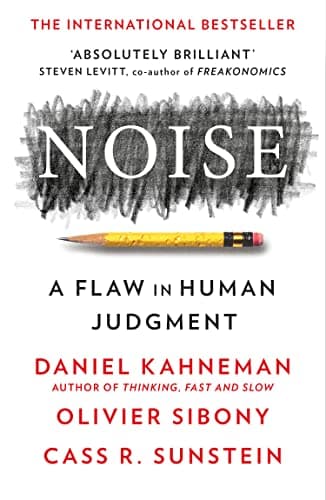
The Noise book arrives with serious pedigree: Daniel Kahneman, Olivier Sibony and Cass Sunstein. Those names alone will move copies. But the premise is not just a brand exercise — it is a genuinely underexplored corner of judgment research. Where Thinking, Fast and Slow mapped cognitive bias and Nudge proposed architecture to steer choices, Noise points at a different failure mode entirely. Two professionals, identical facts, wildly different conclusions. That scatter is noise, and it is everywhere.
The book opens in a insurance underwriting office. Three underwriters, the same case file. Three different premium quotes. None of them is wrong — but one client is getting a raw deal simply because of who happened to pick up the file. It is a quietly shocking scene, and the authors build from there to medicine, hiring, legal sentencing and performance reviews.
Key Features
- Co-authored by Nobel laureate Daniel Kahneman, strategy professor Olivier Sibony and legal scholar Cass Sunstein
- Introduces the concept of "noise" as a distinct and costly failure in human judgment
- Draws on dozens of real-world cases across insurance, medicine, forensic science and corporate hiring
- Proposes a "Noise Audit" framework for organisations to identify and reduce scatter in professional decisions
- Explains the difference between bias (systematic error) and noise (random variability) clearly for the first time
- Offers practical guidance on using algorithms and structured processes to reduce noise
- Hardcover runs 464 pages; audiobook available at approximately 11 hours
Hands-On Review
On a quiet Sunday afternoon I sat down with the hardcover, intending to skim the first few chapters. Four hours later I had missed lunch and was reading the insurance underwriting case for the second time. What got me was not a grand revelation — it was the specificity. The authors do not just argue that people disagree. They show you the data, the methodology, the exact spread between two experts reviewing the same X-ray. It is forensic in a way that most popular science books are not.
I then put it down for three days, which is my real-world test for whether a book earns re-engagement. When I picked it back up, I was into the chapters on professional judgment — the sections on doctors and judges felt like reading dispatches from industries I know something about. A friend of mine who works in medical imaging confirmed the phenomenon described in chapter six: radiologists reading the same scan differently depending on what preceded it. That is noise, and it is not a marginal curiosity.
By week two I had flagged about fifteen passages and started noticing noise in my own decisions — how a prior conversation with a colleague shaped my reaction to their email, something the authors call "context effects." The book does not offer a neat fix, and I think that is honest. Reducing noise in your own head is harder than auditing an organisation's hiring process. The authors know this, which is why the last hundred pages feel slightly more tentative than the opening sections.
What surprised me was the writing quality. Sibony in particular has a gift for the vivid single sentence. Sunstein's legal examples ground abstract points in real consequences — a judge's errant ruling is not an abstract data point when you see what it cost the person on the receiving end. There are places where the three-author structure shows — a point made twice in different chapters — but these are minor roughnesses in a book that mostly sings.
Who Should Buy It?
Readers who devoured Thinking, Fast and Slow will find a familiar voice with a fresh argument. The Noise book functions as a genuine sequel, not a retread. Managers and team leaders responsible for hiring, performance reviews or any process that depends on human judgment will get the most practical value from the Noise Audit framework. Anyone curious about why expert opinions differ so drastically — in medicine, law or finance — will find the case studies absorbing and unsettling. Academics and students in psychology, economics or behavioural science will appreciate the rigorous citation of original research.
Skip this book if you want a quick, formula-driven guide to better decisions. The authors diagnose rather than prescribe, and if that frustrates you, you will enjoy this less than I did. It is also not the right entry point if you have no background in behavioural science at all — some familiarity with basic cognitive psychology helps enormously. Those readers should start with Predictably Irrational or the earlier Kahneman title and come to Noise later.
Alternatives Worth Considering
If the Noise book sounds appealing but you want something more action-oriented, Nudge by Richard Thaler and Cass Sunstein takes a lighter approach to choice architecture with clearer practical takeaways for everyday decision-making. Readers who found Thinking, Fast and Slow inaccessible might prefer Dan Ariely's Predictably Irrational — it covers similar territory with a more playful, anecdote-driven style. For those interested in the intersection of AI and human judgment, Noise opens that door but stops short; in that case, pairing it with a dedicated technology ethics text would round out the picture.
FAQ
Noise: A Flaw in Human Judgment examines the hidden variability in how people make decisions. While bias gets plenty of attention, 'noise' — the inconsistent judgments different people (or the same person) make about identical cases — is equally costly. The authors show noise across medicine, law, insurance and hiring, and propose practical fixes.
Final Verdict
The Noise book does something important: it names a problem that is hiding in plain sight. Variability in judgment is everywhere — in the courtroom, the emergency department, the HR office — and we have been so focused on bias that we missed it. Whether you are a behavioural science enthusiast or a skeptic who found Thinking, Fast and Slow overhyped, give this one a fair shot. The insurance underwriter example alone is worth the price of admission.