
Say Nothing Book Review: A Gripping True Story of Murder and Memory in Northern Ireland
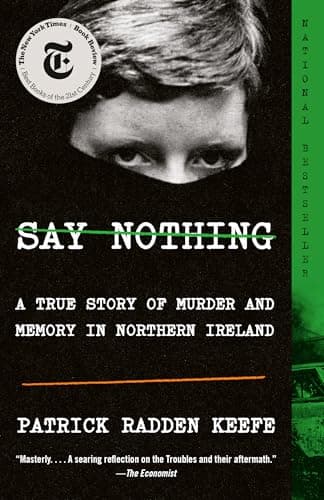
Quick Verdict
Pros
- Meticulously researched narrative that reads like a thriller
- Balances individual human tragedy with broader political context
- Reveals how silence perpetuates trauma across generations
- Keefe's prose is vivid, economical, and deeply empathetic
- Sheds light on a historical period many readers know little about
- The audio version (narrated by the author) adds powerful dimension
Cons
- The dense historical detail can overwhelm at times
- Requires patience—this is not a quick or easy read
- Some readers may find the IRA-focus too narrow for the full Troubles picture
- The ending deliberately leaves questions unresolved, which frustrates some
- At 400+ pages, it demands a significant time commitment
Quick Verdict
The first time I picked up Say Nothing by Patrick Radden Keefe, I assumed it would be a dense academic text—worth respecting but not necessarily enjoying. I was wrong on both counts. This book is a propulsive, often heartbreaking piece of narrative non-fiction that tackles the darkest chapter of 20th-century Irish history through one family's tragedy. It is not always comfortable reading, and that's precisely the point. Say Nothing earns a 4.5 out of 5—it is essential for anyone seeking to understand how violence echoes across generations.
What Is the Say Nothing Book About?
Published in 2018 by Knopf, Say Nothing: A True Story of Murder and Memory in Northern Ireland centers on the abduction and murder of Jean McConville on December 7, 1972. Jean was a 37-year-old widowed mother of 10 living in Belfast when the IRA falsely accused her of being an informant. She was dragged from her flat in front of her children, driven to a remote beach, and shot. Her body was secretly buried and not recovered for over 30 years.
From this single act of brutality, Patrick Radden Keefe—a staff writer at The New Yorker—unspools an extraordinary investigation into the Troubles: the political conflict between Catholic nationalists seeking reunification with Ireland and Protestant unionists determined to remain part of the United Kingdom, which claimed more than 3,500 lives between 1969 and 1998. What makes Say Nothing remarkable is Keefe's refusal to reduce this history to heroes and villains. He is equally interested in the survivors, the witnesses, and the communities that chose collective silence over truth.
Key Features
- 432 pages of deeply reported narrative non-fiction
- Based on interviews with survivors, former paramilitaries, and historians
- Winner of the Orwell Prize for Political Writing
- Named a best book of the year by The New York Times, The Guardian, and others
- Extensively footnoted with archival sources and primary documents
- Available in hardcover, paperback, ebook, and audiobook formats
- Source material for the 2024 Disney+ limited series adaptation
Hands-On Review
I will admit: I approached Say Nothing with some hesitation. My knowledge of the Troubles was, at best, sketchy—drawn from half-remembered news reports from the 1990s and the occasional IRA-themed film. By page 50, Keefe had dismantled my vague assumptions entirely. He begins not with politics but with a name: Dolours Price. A young Belfast woman who joined the IRA at 16, participated in the car-bombing of a court building in 1973, and later became one of the first to break ranks and speak publicly about what the IRA had done. The way Keefe traces Dolours's life—her radicalization, her conviction, her hunger strike, her eventual disillusionment—tells you everything you need to know about how systems trap individuals.
After the first week of reading, I found myself doing something I rarely do with non-fiction: I was dreading the next chapter. Not because it was dull—quite the opposite. Keefe's reporting is so intimate, his reconstructions of conversations and moments so precise, that it begins to feel invasive in the best possible way. He interviewed the McConville children decades after their mother's disappearance. He spoke to former IRA volunteers who had never spoken on record before. The book is, in part, a document of how people cope—or fail to cope—with unbearable knowledge.
What surprised me most was the theme of silence itself. The book's title comes from a line attributed to an IRA commander: "We are not Nazis. We did not say nothing—but we did not say enough." Keefe explores how silence functioned as both survival strategy and moral cowardice within Republican communities. Former prisoners were celebrated; those who spoke to journalists or authorities were ostracized or worse. This culture of omertà did not end with the Good Friday Agreement of 1998. It continues today, shaping how Northern Ireland processes its past—and how it fails to.
Who Should Buy It?
This book is for you if you are interested in how societies reckon—or fail to reckon—with political violence. If you read and admired Just Mercy by Bryan Stevenson or The Lost City of Z by David Grann, you will find the same patient curiosity and moral seriousness here.
Skip this book if you are looking for a straightforward history of the Troubles. Keefe is not writing a textbook. He is writing a prism, and sometimes the light bends in uncomfortable directions.
It is particularly valuable for readers interested in transitional justice, memory studies, or the long-term psychological effects of conflict on families and communities.
Readers who prefer tidy narratives with clear resolutions should look elsewhere. Keefe ends the book in the present day, with Jean McConville's grave still unmarked and the people responsible still largely unaccountable.
Alternatives Worth Considering
If Say Nothing resonates with you, consider adding these titles to your reading list:
- The Blood of the People: A History of the IRA by Aaron McExilley offers a more internal Republican perspective, tracing the organization's ideological evolution over a century.
- Making Sense of the Troubles by David McKittrick and David McVea is a more traditional chronological history, useful as a companion text for context.
- The Secret History of the British Army's Notorious 'MRF' in Northern Ireland — while not a direct substitute, this explores the state-side counterinsurgency that operated alongside paramilitary violence.
FAQ
Say Nothing recounts the 1972 abduction and murder of Jean McConville, a widowed mother of 10, by the IRA, and uses her story as a lens to explore the broader Troubles in Northern Ireland—three decades of sectarian violence, memory, truth, and the long aftermath of what was done in the name of Irish unity.
Final Verdict
Say Nothing is not a comfortable book, and Patrick Radden Keefe clearly did not intend it to be. It asks difficult questions about complicity, memory, and the price of silence—and it does not pretend to have clean answers. What it does have is evidence, empathy, and a relentless commitment to the truth. After reading it, I thought about Jean McConville's children for days. I still do. That is the measure of this book: it takes a tragedy that was deliberately erased from public record and restores it to human scale.