
Separate Is Never Equal Book Review: Sylvia Mendez's Powerful Story
Quick Verdict
Pros
- Engaging true story that fills a major gap in civil rights history for young readers
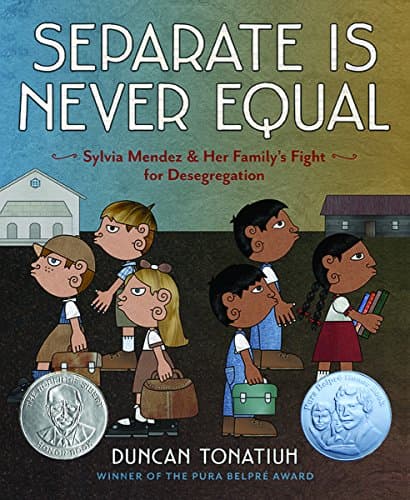
- Duncan Tonatiuth's watercolor illustrations are rich, expressive, and culturally authentic
- Age-appropriate language that respects children's intelligence without oversimplifying
- Won both the Pura Belpré Award and Jane Addams Award — a strong credibility signal
- Works equally well as a read-aloud at home and as a classroom resource
- Back matter includes an author's note and photographs from the actual Mendez family
Cons
- Covers 1940s California segregation — some younger children may need context to fully grasp the historical setting
- The narrative pacing leans slightly measured, which may challenge kids who prefer faster-paced stories
- At 32 pages it feels brief for older readers (grades 5+) who may want more detail on the court case
Quick Verdict
Separate Is Never Equal is one of those picture books that quietly earns a permanent spot on your shelf. Duncan Tonatiuth tells the true story of Sylvia Mendez — a young Mexican-American girl who, in 1946, helped her family dismantle school segregation in California — with warmth, clarity, and just enough tension to keep a kid turning pages. It is honest about discrimination without being heavy-handed, and its illustrations bring depth that words alone couldn't manage. I'd call it essential reading for children curious about civil rights history. Buy the book on Amazon.
What Is the Separate Is Never Equal Book?
Separate Is Never Equal is a nonfiction picture book written and illustrated by Duncan Tonatiuth. It recounts the true story of the Mendez family's fight against school segregation in Orange County, California, in the mid-1940s. Sylvia Mendez, an eight-year-old girl of Mexican and Puerto Rican heritage, was denied enrollment at a whites-only school despite having excellent grades. Her parents — Gonzalo and Felicita Mendez — took action, organizing farmworker families across California and eventually filing a federal lawsuit against several school districts. The case, Mendez v. Westminster School District of Orange County, was decided in 1946 and paved the way for California's desegregation, predating the landmark Brown v. Board of Education ruling by eight years.
The book is published by Abrams Books for Young Readers and spans 32 pages. It has received widespread acclaim, winning both the Pura Belpré Award and the Jane Addams Award — two of the most respected honors in children's literature. It is aimed primarily at children ages 6 to 10, though educators regularly use it with older students as well.
Key Features
- Based on the true Mendez v. Westminster case (1946) — eight years before Brown v. Board
- Written and illustrated by award-winning artist Duncan Tonatiuth
- Rich watercolor illustrations with strong cultural authenticity and visual storytelling
- Back matter includes an author's note, timeline, and real photographs of the Mendez family
- Won the Pura Belpré Award and Jane Addams Award for excellence and social impact
- Suitable for ages 6–10 with classroom applications across grades 2–7
- 32 pages, hardcover and paperback formats available
Hands-On Review
I picked up this book on a rainy Saturday afternoon, expecting to flip through it quickly before returning it to the shelf. Forty minutes later I was sitting on the floor of my living room, reading it a second time. That surprised me, honestly — I hadn't anticipated how deeply Tonatiuth's illustrations would pull me in. The scene where Sylvia walks past her old, underfunded school and peers through a fence at the clean, well-maintained white school across the street says everything without a single word of narration.
The storytelling itself is measured and respectful. It doesn't talk down to children, but it also doesn't overwhelm them with legal complexity. The pacing reminded me of a good documentary — clear context, a building sense of injustice, and a satisfying resolution that actually changed the law. What I appreciated most was the way it frames the Mendez family's fight as an act of community: this wasn't one person's solo crusade, but a collective effort by farmworker families who organized and stood together.
What surprised me was how useful the back matter is. The author's note, the timeline, and the photographs of the real Mendez family transform this from a good picture book into a teaching tool. My one mild criticism is that older readers — say, fourth or fifth graders — might finish it wishing for more. At 32 pages, it necessarily leaves some threads unexplored. That's not a flaw so much as a boundary: it knows what it wants to be, and it does that well.
Will I keep it on the shelf? Without question. It's the kind of book I'll hand to my niece the next time she asks why schools used to be unfair, and it's the kind of book I wish had existed in my classroom five years ago.
Who Should Buy It?
- Parents looking for age-appropriate books that introduce civil rights history and spark meaningful conversations about fairness and justice
- Teachers and librarians building a diverse classroom library or teaching units on the Mexican-American civil rights movement
- Children ages 6–10 who enjoy true stories, especially those interested in history, social justice, or underrepresented voices in American history
- Homeschooling families seeking well-researched, visually engaging resources for elementary-level history and social studies curricula
Skip this one if you're looking for a longer, more detailed historical account — upper middle graders or teens researching the Mendez case in depth will likely need a chapter book or nonfiction title with more extensive detail. This book is a starting point, not an endpoint.
Alternatives Worth Considering
- Marty’s Song by Debbie Levy — a full picture-book biography of Dr. Martin Luther King Jr. for similar age groups, offering a broader look at the Civil Rights Movement
- The Story of Juneteenth by Dorena Williamson — another accessible civil rights history book for younger readers, this time focused on the holiday's origins
- We Are the Ship by Kadir Nelson — an award-winning picture book about Negro League Baseball that offers another gateway into African-American history for children
FAQ
Most publishers recommend ages 6–10, with a reading level around grades 2–5. Teachers and parents often use it successfully with slightly older students (grades 5–7) as a discussion starter for civil rights topics.
Final Verdict
Separate Is Never Equal earns its place among the most important children's books about American civil rights history. Duncan Tonatiuth has created something genuinely special: a story that is honest, accessible, and beautifully illustrated, shining light on a case that changed California — and ultimately the nation — years before Brown v. Board of Education. Whether you are a parent, educator, or young reader yourself, this book offers a powerful window into a chapter of history that deserves far more attention than it typically gets. For anyone building a diverse, meaningful library for children, this one belongs on the shelf.