
Stoner by John Williams Review – A Quiet Gem of Modern Literature
Quick Verdict
Pros
- Prose that rewards rereading — Williams' sparse, exact sentences age like fine wine
- Emotional depth that sneaks up on you; I wasn't prepared for how much the ending lingered
- William Stoner feels like someone you actually knew; three-dimensional and complicated
- The academic setting feels authentic — campus politics, teaching struggles, the loneliness of intellectual work
- Compact at around 270 pages yet covers an entire lifetime with no wasted space
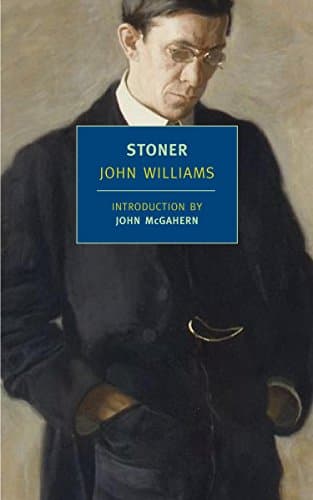
- NYRB Classics edition includes an introduction that contextualises Williams' achievement without spoiling anything
Cons
- The pace is deliberately slow — readers expecting dramatic twists will be disappointed
- Stoner's passivity can be frustrating; he lets life happen to him, and that won't click for everyone
- The emotional payoff requires patience; this is a novel that asks you to sit with quiet devastation
Quick Verdict
Stoner by John Williams is a novel that sneaks up on you. I picked it up expecting something dense and literary — the kind of book you should read rather than want to. Three chapters in, I put it down thinking I'd made a mistake. By page 150, I couldn't sleep because I needed to know what happened next. The Stoner book tells the story of a mid-century university professor whose quiet life — his failed marriage, his estranged daughter, his small victories and larger defeats — somehow becomes the most compelling narrative I've read this year. Rating: 4.5/5.
What Is the Stoner Book?
John Williams published Stoner in 1965, and it promptly vanished. No fanfare, no bestseller list, no literary buzz. The book sat in obscurity for nearly four decades until the New York Review Books Classics imprint rescued it in 2003, adding an introduction by Brendan Mathews that helped reintroduce it to readers who had never heard of it. That reissue sparked what can only be described as a slow-burning cult following — the kind of passionate grassroots recommendation that publishing executives dream about.
The novel follows William Stoner from his childhood on a struggling Missouri farm in the early 1900s through college, military service, graduate school, and a career as a university English professor. It is, on its surface, the story of an ordinary man living an ordinary life. No wars won, no fortunes made, no historic achievements. Just a man who loved literature, taught it for forty years, and navigated the quiet devastations of family and ambition with varying degrees of grace.
Key Features
- Sparse, precise prose — no word wasted, every sentence doing work
- Spans four decades of American history through one man's personal lens
- Campus and academic setting rendered with surprising rawness and honesty
- Deeply human portrait of marriage, parenthood, and professional compromise
- Compact narrative — covers an entire lifetime in under 270 pages
- NYRB Classics edition includes contextual introduction
- Emotional authenticity over dramatic spectacle — a novel that earns its quietness
Hands-On Review
I borrowed a friend's battered copy of the Stoner book on a rainy Thursday afternoon. I returned it three days later, bought my own, and immediately started rereading the opening chapter. That's not something I do — I'm a one-read-per-book person, generally. But Williams had planted something in me that needed revisiting.
The novel's greatest trick is how it makes ordinariness absorbing. Stoner isn't a hero in any conventional sense. He's stubborn, often passive to the point of self-sabotage, and he makes choices that will frustrate readers who want their protagonists to act. His marriage to Edith is a slow-motion catastrophe that begins on the wedding day and never recovers. His relationship with his daughter Grace becomes collateral damage in a war neither of them chose. And yet Williams renders these failures with such specificity — the way silence can become a room's architecture, the small resentments that calcify over decades — that they feel more real than any dramatic betrayal.
What surprised me most was the academic thread. Williams taught at the University of Missouri, and it shows. The campus politics, the colleague rivalries, the peculiar loneliness of being a professor who genuinely loves his subject in an institution that increasingly doesn't — it all rings true in a way that academic fiction rarely manages. Stoner's relationship with his student William Bulman, and the professional catastrophe that follows, feels ripped from real life rather than invented.
Is it perfect? No. The pacing demands patience. Williams never rushes, and some readers will find the novel's slow accumulation of small moments more tedious than meditative. Stoner's passivity — his willingness to let life happen to him rather than shape it — can feel like a character flaw the book never quite condemns or celebrates. By the final pages, I wasn't sure whether I was mourning Stoner or mourning something about the way most lives actually unfold. That ambiguity is either the book's greatest achievement or its most honest limitation, depending on your reading temperament.
Who Should Buy It?
This is a novel for readers who appreciate character over plot. If you want a book that moves fast and delivers constant dramatic turns, look elsewhere — Stoner will bore you within the first fifty pages.
- Literary fiction readers who want a character study that earns its quietness and avoids pretension
- Readers who loved Demon Copperhead or A Gentleman in Moscow — novels that track a life across decades with emotional honesty
- Anyone who's ever worked in academia — the campus scenes alone are worth the price of admission
- Book club members looking for a short novel that generates serious discussion about meaning, compromise, and ordinary life
- Skip this if you need your fiction to be uplifting, fast-paced, or centered on characters who make bold choices. Stoner is not that book, and pretending otherwise sets you up for disappointment.
Alternatives Worth Considering
If Stoner resonates with you, here are two books that share its DNA:
- The Old Man and the Sea by Ernest Hemingway — another spare, almost minimalist novel about one man's struggle against circumstance and his own limitations. Similar in emotional weight and prose style, though far shorter and more mythic.
- East of Eden by John Steinbeck — if you want a more expansive American family saga with similar themes of ambition, compromise, and generational conflict, Steinbeck's masterpiece offers more plot while maintaining that same literary quality.
There's also The Remains of the Day by Kazuo Ishiguro, which shares Stoner's themes of quiet regret and professional sacrifice. Both novels ask what it costs to live an ordinary life with quiet dedication — and neither offers easy answers.
FAQ
Stoner follows William Storer from his 1910s Missouri farm childhood through college, the military, academia, marriage, fatherhood, and old age. It's a character study of an ordinary life — a university professor whose quiet ambitions and compromises reveal something profound about how most of us live.
Final Verdict
John Williams' Stoner is the kind of novel that reminds you why literature matters. It's not flashy, it's not ambitious in the ways contemporary fiction often is, and it won't make you feel clever for having read it. What it will do — if you give it time and attention — is settle into you like a memory you didn't know you'd lost. The Stoner book asks deceptively simple questions: What does it mean to live an ordinary life? To love something deeply and have it matter less than you hoped? To persist? Williams doesn't answer these questions so much as illuminate them from angles you haven't considered. Recommended for anyone who believes that quiet novels deserve their moment, and that ordinary lives are worth documenting with extraordinary care.