
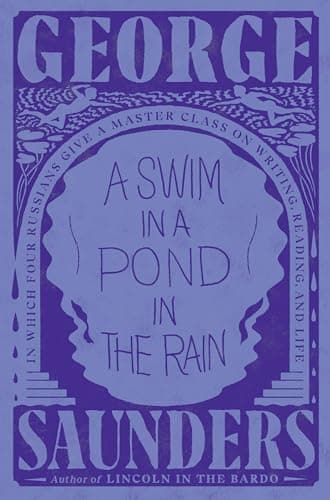
A Swim in a Pond in the Rain Review: George Saunders' Writing Masterclass
Quick Verdict
Pros
- Deep, actionable insights into what makes fiction work at the sentence level
- Four classic Russian stories included in full for hands-on analysis
- Saunders' conversational teaching style makes complex concepts accessible
- Practical exercises and questions you can apply to your own writing immediately
- Balances intellectual depth with warmth and humor
Cons
- Assumes some familiarity with fiction—raw beginners may feel lost at times
- The Russian-centric approach won't appeal to those seeking broader literary examples
- Some readers might find the analysis too granular for casual interest
Quick Verdict
If you're serious about understanding what makes fiction tick, A Swim in a Pond in the Rain is one of the most rewarding writing books I've encountered in years. Saunders doesn't just tell you what works—he shows you, line by line, across four Russian short stories that have genuinely shaped how I read everything since. Score: 4.5 out of 5.
What Is A Swim in a Pond in the Rain?
I picked up Saunders' book on a grey Saturday morning with coffee going and no particular agenda. Within twenty pages, I realized this wasn't another craft book full of vague advice about "showing versus telling." Instead, Saunders—a Booker Prize-winning author—sits you down and walks you through four Russian stories like a patient mentor who genuinely wants you to get it.
The premise is elegant: Saunders taught a course at Syracuse University for over a decade, and this book captures that experience. He includes the full texts of four stories—Chekhov's 'In the Cart' and 'The Daughter of Albion,' Tolstoy's 'Master and Man,' and Gogol's 'The Nose'—then breaks each one apart to examine the choices a writer makes at every level. Word choice. Sentence rhythm. When to withhold information. When to fast-forward through time. When a character's internal state matters more than external action.
Key Features
- Four complete Russian short stories reproduced in full for hands-on analysis
- Close reading of sentence-level craft choices with clear explanations of why they work
- Saunders' own commentary woven through each chapter like a masterclass dialogue
- Practical reflection questions at the end of each story section
- Insights into the teacher-student dynamic that shaped the book's tone
- Discussion of how Russian literary tradition differs from Western approaches
- Accessible explanations of sophisticated narrative techniques
Hands-On Review
Here's what surprised me: I expected dry academic analysis. What I got was something closer to sitting in a really good graduate seminar—Saunders questions his own assumptions, sometimes changes his mind mid-argument, and never pretends there's a formula. He once wrote a version of 'In the Cart' differently in his notebook just to prove a point about a structural choice. That's the level of rigor here.
By the time I finished the chapter on Tolstoy's 'Master and Man,' I caught myself re-reading passages from a novel I'd been working on with entirely different eyes. Suddenly I noticed where I'd been lazy—where I'd told instead of shown, where I'd resolved tension too quickly, where I'd missed opportunities to let a scene breathe. Saunders won't give you a checklist. What he gives you is a sensitivity, a radar for recognizing what a story needs.
The chapter on Gogol's 'The Nose' is particularly eye-opening. It's an absurd story—literally about a nose that detaches and gains social prominence—and Saunders uses it to discuss how comedy and existential weight can coexist, how strangeness in fiction serves emotional truth rather than mocking it. I reread that story three times with his notes, and each pass revealed something I'd missed.
Not everything lands perfectly. Some of the analysis in the earlier chapters felt slightly unfocused, and there were moments where I wanted Saunders to be more prescriptive. But honestly? That tentativeness is part of what makes the book feel honest. He's not selling you a system. He's inviting you into a practice.
Who Should Buy It?
This book is ideal if you're a fiction writer—amateur or professional—who wants to understand the mechanics behind why certain stories resonate. It's equally valuable for serious readers who've ever wondered why a particular story stuck with them long after finishing it.
Creative writing instructors might find the reflection questions useful for classroom use, and book club leaders could use the analysis chapters as discussion prompts.
Skip this if you're looking for a step-by-step writing guide with formulas and templates. Saunders isn't interested in shortcuts, and this book won't give you any. If you need a prescriptive approach to plot structure or character arcs, look elsewhere.
Also, if you have zero interest in Russian literature, the specific examples won't appeal to you—though honestly, after reading Saunders' analysis, you might find yourself curious.
Alternatives Worth Considering
If A Swim in a Pond in the Rain appeals to you but isn't quite the right fit, consider these alternatives:
Reading Like a Writer by Francine Prose takes a similar close-reading approach but draws from broader Western literature. Less focused on Russian tradition, more accessible for absolute beginners.
The Art of Fiction by John Gardner remains a classic craft text, though more essayistic in tone. Gardner offers philosophy alongside practical advice, making it a different but complementary read.
Bird by Bird by Anne Lamott offers a more personal, humorous take on writing craft. Less analytical, more about the emotional realities of sustaining a writing life. Great if you want warmth over rigor.
FAQ
It's a writing craft book where George Saunders analyzes four classic Russian short stories—ones he taught for years at Syracuse University—to reveal how great fiction works. Each chapter includes the full story followed by Saunders' close reading of its techniques.
Final Verdict
A Swim in a Pond in the Rain isn't a quick fix or a productivity hack for your writing. It's something more valuable: a genuine education in attention. Saunders teaches you to slow down, to question every choice a writer makes, and to develop an instinct for what fiction needs at any given moment. Whether you ultimately agree with his interpretations matters less than the habit of looking closely—that's what stays with you long after you close the cover.
Will I keep recommending this to fellow writers? Definitely. It's become one of those books I lend to anyone who asks how to level up their fiction reading and writing simultaneously.