
The Four Agreements Book Review: Is This Toltec Wisdom Worth Your Time?
Quick Verdict
Pros
- Concise and digestible - four agreements you can memorize in minutes
- Practical principles that apply to everyday communication and self-talk
- Durable hardcover with quality paper that feels good to hold
- Readable prose - Ruiz writes clearly without academic jargon
- Compact enough to re-read regularly as a daily reference
- Encourages genuine self-reflection without religious baggage
Cons
- Some principles feel oversimplified for complex emotional trauma
- The Toltec spiritual framing may not resonate with secular readers
- Lack of concrete exercises or worksheets to actively practice the agreements
- At under 150 pages, some readers may feel they want deeper exploration
Quick Verdict
The Four Agreements by The Four Agreements delivers exactly what its title promises: four agreements, clearly explained, that can genuinely shift how you communicate with yourself and others. After living with this book for two weeks—taking notes, testing the principles in real conversations, and yes, sometimes failing to follow them—I can say it earns its spot as a modern self-help staple. That said, it won't fix deep-seated trauma, and its spiritual framing isn't for everyone. Rating: 4.5/5.
What Is the The Four Agreements?
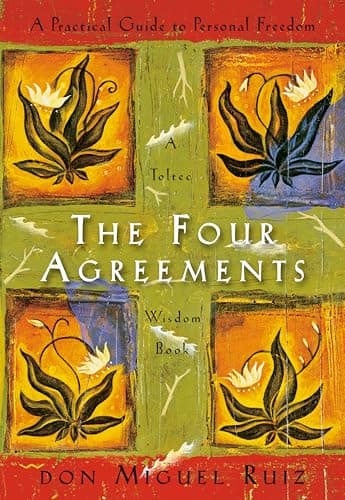
First published in 1997, The Four Agreements distills ancient Toltec wisdom into four simple principles for personal freedom. Don Miguel Ruiz, a Mexican author and spiritual teacher, presents these as codes of conduct passed down through generations of Toltec naguals (shamans). The agreements are: Be impeccable with your word. Don't take anything personally. Don't make assumptions. Always do your best. Sounds simple. In practice? That's where things get interesting.
The book runs about 151 pages in the standard hardcover edition. It's not a dense philosophical treatise or a clinical psychology manual—it's more like a philosophical toolkit wrapped in spiritual language. Ruiz writes in accessible, almost parable-like prose, which makes it easy to read in a single weekend but also means you can return to it again and again without feeling like you're cracking a code.
Key Features
- Four core agreements distilled into memorable, actionable principles
- Accessible writing style - no prior knowledge of Toltec culture required
- Compact 151-page format designed for repeated reading and reference
- Durable hardcover edition with quality paper and readable typography
- Available in multiple formats: paperback, hardcover, ebook, and audiobook
- Includes practical examples showing how each agreement plays out in daily life
- Popular companion journal and study guide editions available separately
Hands-On Review
I picked this up after a particularly rough month of miscommunications at work and friction in a close friendship. I'd seen The Four Agreements mentioned in podcasts, recommended by influencers, and sitting on countless "life-changing books" lists. I was honestly skeptical—how much can four rules really do?
The first agreement, "Be impeccable with your word," hit me hardest. I've always been a sarcastic person, and Ruiz's framing of the word as "the most powerful tool you have" made me reconsider every flippant comment I'd made in the previous weeks. I won't pretend I became perfect overnight. By day three, I'd already broken this agreement twice while half-asleep scrolling through emails. But the awareness stuck.
Agreement number two, "Don't take anything personally," turned out to be the hardest for me. When my manager sent a brief, clipped email on a Tuesday morning, my brain immediately went to worst-case scenarios. Ruiz argues that other people's actions are about them, not us—a reframing I'd heard before but never seriously applied. Sitting with that concept during my lunch break, I realized I'd spent years internalizing casual comments from people who were simply having bad days.
The book's spiritual framing (Toltec naguals, dream teachings, energy fields) won't land for everyone. I consider myself agnostic on most spiritual matters, and I found myself skimming a few paragraphs about "the dream of the planet" without much engagement. But the core principles hold up regardless of whether you buy into the mystical wrapping. The physical book itself feels solid—good paper weight, clear text, the kind of book that survives being stuffed in a bag and reread on planes.
Who Should Buy It?
Buy this if you're looking for a quick, accessible entry point into self-reflection and want concrete principles you can start applying today. If you struggle with what people think of you, find yourself assuming the worst in conversations, or tend to speak carelessly when stressed—this book speaks directly to those patterns.
Buy this if you're a chronic overthinker who responds to simple frameworks rather than complex psychological models. Ruiz gives you four things to remember, not forty.
Skip this if you need evidence-based psychology or therapeutic frameworks. The Four Agreements is philosophical and spiritual, not clinical. If you're dealing with anxiety disorders, trauma, or depression, seek a licensed professional—not a Toltec wisdom book.
Skip this if you dislike spiritual or new-age framing. The Toltec cosmology isn't subtle here. If terms like "energy fields" and "ancient wisdom" make you roll your eyes, you'll spend more time being annoyed than absorbing the message.
Alternatives Worth Considering
If you're drawn to self-help but want a more secular, psychology-backed approach, The Seven Habits of Highly Effective People by Stephen Covey offers a similar framework structure with more empirical grounding—though it's longer and denser. For those who found The Four Agreements impactful and want deeper Toltec teaching, Ruiz's follow-up The Mastery of Love explores relationships through the same lens. Or, if you want something even shorter and more modern, Atomic Habits by James Clear focuses on habit systems rather than agreements but delivers equally actionable life changes.
FAQ
The Four Agreements are: 1) Be impeccable with your word, 2) Don't take anything personally, 3) Don't make assumptions, and 4) Always do your best. Ruiz presents these as ancient Toltec teachings for personal freedom.
Final Verdict
The Four Agreements earns its reputation as a gateway book for a reason. It's short enough to finish in a weekend, memorable enough to actually remember, and practical enough to start applying immediately. Is it life-changing? That depends entirely on what you do with it. Read it, dog-ear the pages, and forget about it? Probably not. Return to the four agreements when you're about to send an angry email, or before a difficult conversation? That's where the magic is. The spiritual framing isn't mandatory—you can strip out the Toltec cosmology and still walk away with four genuinely useful principles for navigating life with less suffering. Check current pricing on Amazon using the link below.