
The Goldfinch Book Review: Donna Tartt's Pulitzer Winner Worth It?
Quick Verdict
Pros
- Pulitzer Prize-winning prose that rewards attentive readers with dense, layered sentences
- Complex protagonist whose moral contradictions feel uncomfortably real
- Intricate plot that weaves art theft, grief, addiction, and class struggle into one narrative
- World-building around New York's art scene that feels lived-in and specific
- Ending that provokes genuine reflection rather than easy closure
Cons
- At nearly 800 pages, the pacing sags noticeably in the middle third
- Theo's voice can feel self-justifying to the point of irritation
- Some secondary characters never fully develop beyond their function in the plot
- Dense literary style may alienate readers who prefer plot-driven storytelling
Quick Verdict
Donna Tartt's The Goldfinch book review has to start with a confession: this novel broke my reading habits. I picked it up expecting a straightforward thriller built around an art heist. What I got was something far more demanding—and, ultimately, far more rewarding. The Goldfinch is a nearly-800-page meditation on grief, guilt, beauty, and the objects we cling to when everything else falls apart. It's not for everyone. But if you've got the time and the patience for a novel that asks you to stay with it, this Pulitzer Prize winner delivers something rare: a story that genuinely lingers. Rating: 4.2/5
What Is the The Goldfinch?
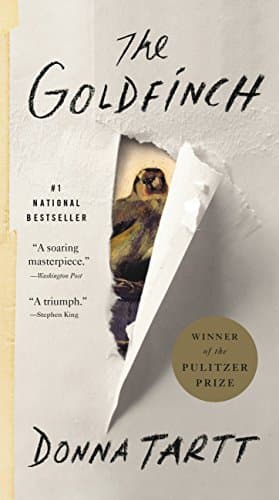
The Goldfinch is a literary novel by Donna Tartt, published in 2013 by Little, Brown. It won the 2014 Pulitzer Prize for Fiction—a recognition that placed Tartt in the company of Toni Morrison, Cormac McCarthy, and other titans of American letters. The novel centers on Theo Decker, a 13-year-old New Yorker who survives a terrorist bombing at a museum while his mother dies. In the chaos, he steals a small Dutch painting: Carel Fabritius's The Goldfinch, a 1654 masterpiece depicting a chained goldfinch. What follows is a sprawling, decades-spanning narrative about what that act of theft—and that painting—does to a life.
Key Features
- Winner of the 2014 Pulitzer Prize for Fiction
- 771 pages of literary fiction with sustained narrative ambition
- Unreliable first-person narrator with contradictory moral instincts
- Intersecting storylines spanning 13 years and multiple American cities
- Exploration of art, trauma, addiction, class, and identity
- Published by Little, Brown and Company
- Adapted into a 2019 feature film directed by John Crowley
Hands-On Review
I bought my copy on a rainy Thursday in October—a 771-page paperback that felt like holding a small brick. That's not a complaint. There's something reassuring about a novel that announces its seriousness through sheer physical weight. I won't pretend I was hooked from page one. The opening chapter, set in the immediate aftermath of the bombing, is genuinely harrowing—but the narrative then pulls back into Theo's fragmented childhood memories, and the pacing initially feels disorienting.
By the end of the first week, though, something shifted. Tartt's prose, which initially seemed self-consciously literary, started to feel like the only voice that could tell this story. She writes about art and beauty and the strange comfort of objects with an intensity that I found almost physical. I dog-eared a passage on page 340 where Theo describes what it feels like to look at the stolen painting in the middle of the night. I read it three times. That's not something I usually do.
Where the book struggles—and I think honest The Goldfinch book review pieces have to acknowledge this—is in the middle third. The plot dilates. Theo's life in Las Vegas, then his return to New York, stretches out in ways that test reader patience. Some of the secondary characters (Hobie, Pippa, even Barbour) feel like they exist primarily to reflect aspects of Theo's psychology rather than as fully realized people. I put the book down twice during this stretch and genuinely considered not picking it back up.
What brought me back was the final act. The convergence of Theo's storylines, the reckoning with what he's done and who he's become, delivers an emotional payoff that feels earned precisely because Tartt didn't rush it. The ending won't satisfy readers who need narrative closure. But if you can sit with ambiguity—if you can accept that some questions don't have answers—The Goldfinch offers something more honest than resolution.
Who Should Buy It?
- Literary fiction readers who savor dense, layered prose and don't need plot-driven momentum
- Book club members looking for novels that generate genuine discussion about moral ambiguity and personal responsibility
- Readers processing grief or loss—Tartt's exploration of what we hold onto and why feels authentic and compassionate
- Anyone who loved The Secret History and wants to see Tartt working at her most ambitious scale
Skip this if you're looking for a fast-paced thriller, if 700+ pages feels prohibitive, or if you need your protagonists to be likable. Theo is brilliant, magnetic, and deeply unreliable—he lies to himself as easily as he breathes. If that frustrates you, this won't change.
Alternatives Worth Considering
If The Goldfinch sounds appealing but the commitment feels steep, consider these options:
- The Secret History by Donna Tartt — Tartt's debut is darker, tighter, and set at a small Vermont college. If you loved The Goldfinch's atmosphere, this is the obvious next step, and at under 500 pages, it's a gentler entry point.
- Atonement by Ian McEwan — Another novel about a single act of destruction rippling across a lifetime. McEwan's prose is equally precise, his protagonist equally flawed. At under 350 pages, it delivers similar themes in a more compressed form.
- The Remains of the Day by Kazuo Ishiguro — For readers drawn to novels about regret, memory, and the things left unsaid. Stevens, the narrator, shares Theo's capacity for self-deception—but Ishiguro's restraint makes for a very different reading experience.
FAQ
The novel follows Theo Decker, a 13-year-old boy who survives a terrorist bombing at a museum while his mother dies. He steals a priceless painting—Carel Fabritius's 'The Goldfinch'—and the story traces his life through adolescence and adulthood as he grapples with grief, guilt, and the painting's mysterious pull.
Final Verdict
The Goldfinch is not a perfect novel. It's too long, too self-indulgent in places, and its central character will frustrate readers who want moral clarity from their protagonists. But perfection isn't what Tartt is going for. What she delivers, across 771 dense and demanding pages, is something harder to quantify: a novel that feels genuinely alive, that argues for literature's ability to capture the messy, contradictory truth of being human. I closed the book on a Sunday night and sat in silence for ten minutes. That's not something that happens to me often. If you're willing to give it the time it asks for, this Pulitzer Prize winner will reward you.