
The Wager by David Grann Review: Shipwreck, Mutiny & Murder
Quick Verdict
Pros
- Grann's narrative writing makes 18th-century maritime history feel immediate and cinematic
- Deep character work brings the sailors' desperation to life
- Meticulous research grounds every dramatic moment in documented history
- The mutiny investigation raises genuinely unsettling moral questions
- Pacing balances survival horror with courtroom drama effectively
Cons
- The middle section slows noticeably during extended camp scenes
- Some readers may find the historical context dense in places
- The ending leaves certain historical questions deliberately unresolved
Quick Verdict
The Wager by David Grann takes you aboard an 18th-century British warship bound for glory and delivers something far stranger and darker—a story of survival, mutiny, and the slippery nature of truth when lives hang in the balance. Grann's latest is a masterclass in turning dry historical records into propulsive narrative non-fiction. I'd give it a strong recommendation for anyone who loves history that reads like a thriller. Rating: 4.7/5.
What Is The Wager?
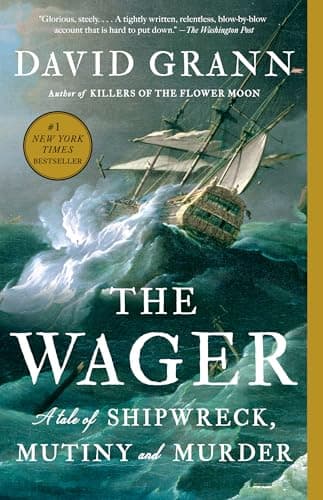
The Wager is a 2023 historical non-fiction book by journalist and author David Grann, published by Vintage Books. It recounts the ill-fated voyage of HMS Wager, a British warship dispatched in 1741 as part of Commodore George Anson's expedition to raid Spanish holdings in the Pacific. After being separated from the fleet during a violent storm off Cape Horn, the Wager ran aground on a desolate island off the coast of Patagonia—what would become known as Wager's Island.
The survivors faced starvation, scurvy, and brutal infighting. A faction of men, believing the ship beyond repair, took a smaller vessel and sailed north—some toward mutiny, others toward survival. The remaining castaways, including the Wager's young captain, eventually made it to Chile and were repatriated to England. There, a court-martial convened to determine who was responsible for the disaster and whether crimes had been committed. Here is where Grann's narrative truly sharpens: the competing testimonies, the accusations of murder, and the question of whether the mutineers were villains or simply men who had lost all hope of rescue.
Key Features
- Based on extensive primary source research including ship logs, letters, and court-martial transcripts
- Dion Graham audiobook narration praised for bringing 18th-century voices to life
- Approximately 320 pages—substantial but not overwhelming
- Interweaves vivid survival narrative with a legal thriller about truth and accountability
- Explores class tensions, military hierarchy, and the psychology of desperation
- Published by Vintage Books in 2023 as a hardcover and ebook
Hands-On Review
I picked up The Wager on a recommendation from a friend who knows I'm partial to maritime history, though I'd only read one Grann book before—The Lost City of Z. From the first pages, I noticed the same signature: he drops you into a specific moment—the Wager being battered by waves, the crew exhausted—and then expands outward until you realize you're holding an entire world.
By chapter three, I was genuinely uneasy. The account of what happened on Wager's Island isn't comfortable reading. Grann doesn't soften the desperation: men dying of scurvy, arguments over dwindling food supplies, the slow collapse of order. What surprised me was how the book shifts registers—it moves from survival horror to something almost like a legal procedural once the survivors reach civilization and the accusations begin flying. The question of who killed a gunner named John Bryan, and why, kept me turning pages long past my bedtime.
The middle section, I'll admit, tested my patience. There's a stretch where the surviving crew members are essentially stranded with little narrative momentum. Grann does what he can with camp politics, but you're waiting for the other shoe to drop. When it does—in the form of the court-martial proceedings—the book finds its footing again and doesn't let go.
The ending is deliberately unresolved in places. Grann acknowledges that some questions can't be answered definitively from the historical record. I found this refreshing rather than frustrating; it mirrors how the men themselves must have felt, trapped between competing versions of events. Is this a story about the corruption of power, or the limits of human endurance, or both? Grann lets you decide.
Who Should Buy It?
This book is ideal if you:
- Enjoy historical non-fiction that reads like a novel—think Erik Larson or Candice Millard
- Have read and liked David Grann's previous work (Killers of the Flower Moon, The Lost City of Z)
- Are fascinated by stories of survival, maritime disasters, or 18th-century naval history
- Appreciate books that explore moral ambiguity and the nature of truth under pressure
- Want a substantial but accessible read for a book club—there's plenty to discuss
Skip this one if you're looking for a straightforward adventure tale without much psychological depth. The Wager is more interested in why people behave the way they do when civilization falls away than in plotting a straight survival arc. Also, if you struggle with graphic descriptions of illness and violence, be warned: Grann doesn't sanitize the realities of 18th-century life at sea.
Alternatives Worth Considering
If The Wager sounds appealing but you want to compare options:
- Dead Wake by Erik Larson — Another maritime disaster narrative (Lusitania), written in Larson's signature dual-timeline style. Less about mutiny, more about the mystery of why the ship was torpedoed.
- Killers of the Flower Moon by David Grann — If you haven't read this yet, it's arguably Grann's most acclaimed work. Same investigative approach, different (and darker) subject matter.
- The Ship That Died by Sara Wheeler — A narrative account of Shackleton's Endurance voyage. More polar-focused than Wager, but shares DNA in terms of survival extremity and leadership ethics.
FAQ
The Wager recounts the true story of HMS Wager, a British warship that was wrecked in 1741 near the coast of Patagonia during a voyage to capture Spanish treasure ships. The survivors endured extreme hardship, and a faction eventually mutinied. The book follows the subsequent court-martial that investigated the mutiny and the conflicting accounts of what happened.
Final Verdict
The Wager by David Grann confirms what readers of his earlier books already suspected: he's one of the best narrative non-fiction writers working today. He takes a relatively obscure episode of 18th-century maritime history and makes it feel urgent and personal. Yes, the middle drags a bit, and the ending won't satisfy readers who want clean answers. But those are small complaints against what is ultimately a gripping, thoughtful book about what people are capable of when everything familiar has been stripped away. If you want a history book that'll keep you up past midnight, check current pricing on Amazon.