
Thinking, Fast and Slow Review: Is It Worth Reading in 2024?
Quick Verdict
Pros
- Nobel Prize-winning author brings unmatched credibility and decades of research
- Transforms abstract cognitive science into concrete, applicable insights
- Deeply researched yet surprisingly readable prose for an academic work
- Permanent shift in how you perceive your own decision-making processes
- Covers the full spectrum of human cognitive biases systematically
Cons
- Demanding 500-page commitment requires significant time investment
- Dense chapters demand full attention—audiobooks may strain focus
- No practical step-by-step guide or action items included
- Academic tone occasionally surfaces despite accessible writing
Quick Verdict
Thinking, Fast and Slow by Daniel Kahneman is one of those rare books that genuinely reshapes how you see yourself. The Nobel laureate distills decades of research into why humans make predictably irrational choices—and does it with enough clarity that you don't need a psychology degree to follow along. It's not a quick read, and it won't hand you a five-step plan for better decisions. What it will do is make you catch yourself, mid-thought, second-guessing the gut instincts you once trusted blindly. Score: 4.5/5. If you're willing to put in the hours, this book pays dividends that compound over years.
What Is the Thinking, Fast and Slow?
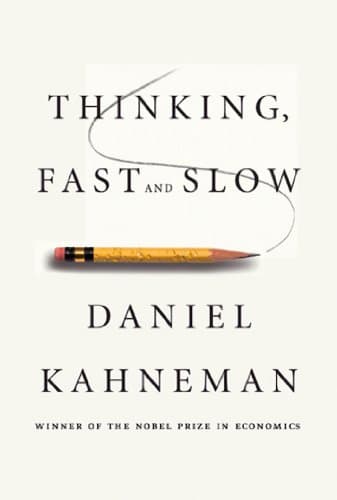
First published in 2011 by Farrar, Straus and Giroux, Thinking, Fast and Slow is Daniel Kahneman's flagship synthesis of behavioral economics and cognitive psychology. You might know Kahneman from his 2002 Nobel Prize in Economic Sciences—a rare honor for someone who never set foot in an economics department. The book grew out of a lifetime partnership with Amos Tversky, the collaborator whose early death left Kahneman to finish their joint vision alone.
At its core, the book maps the mind through two fictional characters Kahneman calls System 1 and System 2. System 1 runs automatically—it's the fast, intuitive, emotionally charged operator that recognizes a friend's face across a room, detects hostility in a voice, and completes the phrase "bread and…" without conscious effort. System 2 is the slow, deliberate, effortful counterpart that handles algebra, compares two product warranties, and parks a car in a tight space. Most of the time, these two systems cooperate smoothly. It's when System 1 oversteps—when it substitutes an easier question for a harder one, or when it mistakes familiarity for truth—that trouble arrives.
Key Features
- Two-System Framework: System 1 (fast, automatic) and System 2 (slow, deliberate) structure every chapter
- Availability Heuristic: Why things that come to mind easily feel more common—and more true
- Loss Aversion: The pain of losing $100 outweighs the pleasure of gaining $100
- Endowment Effect: You value things you own more than things you don't
- Two Selves: Experiencing self versus remembering self, and why this distinction matters
- Predictable Overconfidence: Why we systematically overestimate our knowledge and abilities
- Framing Effects: Identical situations presented differently produce wildly different choices
Hands-On Review
I cracked the spine on a rainy Sunday with coffee going cold beside me—probably the fourth time I'd picked it up over the years before finally committing. What I noticed immediately was the quality of the writing. This isn't a textbook with delusions of accessibility. Kahneman writes like someone who genuinely enjoys sentences, and he isn't afraid to use "I" when describing his own mistakes, blind spots, and mid-experiment surprises.
By the time I hit Chapter 4, I'd already had two moments where I had to set the book down and just think. Not because it was confusing—because it was uncomfortably accurate. Kahneman describes a study where法官 making parole decisions become systematically more generous right after a lunch break. The numbers were damning. And the thing is, I knew immediately that I'd done the same thing in my own life: mistaking cognitive ease for confidence, treating a fluent reading experience as evidence of truth.
The middle section of the book—Parts 3 and 4, covering the famous heuristics and biases program—felt dense in a way that rewarded note-taking. I started flagging passages with actual sticky tabs, which I almost never do. Some chapters are essentially journal articles compressed into prose. But Kahneman's willingness to revise his own conclusions mid-book impressed me. He doesn't pretend certainty where none exists.
After finishing, I didn't feel like I'd acquired a new skill. I felt like I'd been handed a map of terrain I'd been navigating blind my whole life. Whether that map makes you a better navigator depends entirely on whether you revisit it.
Who Should Buy It?
This book belongs on your shelf if you fall into any of these groups:
- The genuinely curious: You want to understand why smart people consistently make dumb choices—and you're willing to spend 15-20 hours finding out.
- Professionals in persuasion-heavy fields: Marketers, product designers, negotiators, and policy advocates who need to understand the levers behind human judgment.
- Anyone who's ever wondered why they still believe something long after the evidence should have changed.
Skip this if you want a productivity system, a leadership playbook, or anything resembling tactical advice. Kahneman doesn't offer three easy steps to better decisions. What he offers is harder and more valuable: a set of conceptual tools for recognizing when your own mind is working against you. If that sounds like homework, it is.
Alternatives Worth Considering
If Thinking, Fast and Slow feels like too much commitment right now—or if you've finished it and want complementary perspectives—these alternatives each take a different angle:
- Predictably Irrational by Dan Ariely: Lighter, funnier, more anecdote-driven. Easier to power through in a weekend, though less rigorous. Great as a gateway drug to behavioral economics.
- Superforecasting by Philip Tetlock: Narrower focus on prediction and expert judgment, with practical techniques that Kahneman deliberately avoids. More action-oriented.
- Nudge by Richard Thaler and Cass Sunstein: Takes the insights of behavioral economics and asks: how should we design choice environments? Different purpose, same intellectual family.
FAQ
Yes, if you want a fundamental understanding of how human judgment works. It's demanding but rewarding. Skip it if you want quick, actionable advice.
Final Verdict
Thinking, Fast and Slow earns its reputation not as a life-hack manual but as a permanent upgrade to your self-awareness. The two-system model isn't just a framework for understanding others—it's a mirror held up to your own cognitive habits. Will you apply every insight? Almost certainly not. But you'll catch yourself more often, and that's worth something.
The book's density is a feature, not a bug. It's meant to be absorbed slowly, revisited, argued with. If you approach it as a weekend read, you'll come away frustrated. Approach it as the serious, landmark work it is, and you'll find yourself thinking about it years later—which is more than most books can claim.