
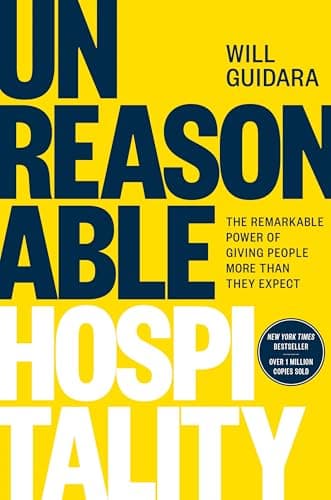
Unreasonable Hospitality Book Review: Is Will Guidara's Guide Worth Reading?
Quick Verdict
Pros
- Practical framework applicable across industries, not just restaurants
- Story-driven narrative makes concepts stick without feeling textbook-ish
- Challenges the baseline of what adequate service even means
- Encourages teams to think like owners of the experience, not employees
- Concrete examples of small gestures that created outsized loyalty
Cons
- Some readers may find the fine-dining context hard to translate to their field
- Stories occasionally run long when a tighter summary would hit harder
- Doesn't deeply address the financial ROI side for skeptical managers
- Published in 2022 — eager readers may have already absorbed the core ideas elsewhere
Quick Verdict
The Unreasonable Hospitality book by Will Guidara took me about three evenings to finish, and I kept stopping to text friends about specific stories. That's the tell. Most business books I'd highlight a paragraph and move on. This one made me want to argue about it at brunch. If you interact with other humans as part of your work — which is almost everyone — Guidara's framework for delivering unreasonable care will reframe how you think about service, leadership, and what it even means to do a good job. Score: 4.5 out of 5.
What Is the Unreasonable Hospitality Book?
Will Guidara ran Eleven Madison Park, the restaurant that became the first fully plant-based establishment to earn a Michelin three-star rating. Before that pivot, it was already one of New York's most decorated fine-dining destinations. But the book's premise isn't really about fine dining — it's about the transferable magic that happens when a team commits to exceeding expectations at every touchpoint, not just the obvious ones.
Guidara defines unreasonable hospitality as the deliberate choice to give people more than they expected, even when — especially when — they can't articulate what they wanted in the first place. It's the instinct to notice a child's restlessness at a fancy dinner and quietly arrange for crayons and a coloring book. It's remembering that a guest mentioned their anniversary three visits ago and quietly making sure the evening feels special without being performative. The book is part memoir, part operating manual, and entirely convinced that excellence is a cultural act, not a script.
Key Features
- Story-first structure: real moments from Eleven Madison Park anchor every principle
- Applicable beyond restaurants: retail, hotels, healthcare, and internal team culture
- Honest about failures: Guidara doesn't hide the missteps that shaped his approach
- Short, readable chapters: each one lands a single idea without padding
- Actionable framing: each chapter ends with a prompt to ask "What can we give more of?"
- Focus on employee experience: argues that unreasonable hospitality starts with treating your team right
- Accessible tone: no industry jargon, written for any reader willing to show up fully
Hands-On Review
I'll admit it — I picked this up thinking it would be a niche restaurant-industry read. I'm not in hospitality. I'm in B2B software, which sounds about as far from Eleven Madison Park as you can get. What I didn't expect was how quickly Guidara dismantled that excuse. Within the first thirty pages he makes the case that every company is in the hospitality business whether it knows it or not. You're either in the business of making people feel something when they interact with you, or you're leaving that territory to someone else who will.
The story that stuck with me: a guest arrived at Eleven Madison Park clearly in distress. The table next to them had just been proposed to — the couple was glowing, photographers were called, it was a whole scene. The distressed guest was clearly going through something heavy. Guidara's team didn't ask what was wrong. They quietly moved the couple's dessert presentation to a different section of the restaurant so the grieving guest wouldn't have to watch the celebration while eating alone. Nobody asked them to do that. There was no form for it. It was a judgment call made by people who had internalized that their job wasn't to serve food — it was to hold the emotional temperature of the room.
That example sat with me for days. I started noticing all the moments in my own work where we were doing the functional thing — shipping the feature, answering the ticket — but missing the actual human on the other side. Guidara's argument isn't that you need to do grand gestures. It's that the accumulation of small, thoughtful choices compounds into something clients remember and talk about. What surprised me was how explicitly he credits the team, not leadership, for this culture. He writes about hiring for values, not just skills, and creating an environment where front-line employees feel empowered to make judgment calls without escalation. That's harder than it sounds, and he doesn't pretend otherwise.
The book isn't without friction for a skeptical reader. Guidara writes from a world of expense accounts and tableside theatrics, and some of the examples feel like they're from a parallel universe if your customer interactions happen over Zoom or at a service counter. But the principles hold. The second half of the book explicitly addresses this gap, with chapters on applying unreasonable hospitality to healthcare, education, and corporate culture. Those sections feel a bit thinner than the restaurant stories — probably because the anecdotes are secondhand — but the bones are solid.
Who Should Buy It?
- Leaders and managers who want to build a service culture that doesn't depend on scripts or micromanagement
- Customer-facing professionals in any industry who feel stuck in the "adequate" zone and want a framework for going further
- Entrepreneurs and founders building a brand where customer experience is a differentiator, not an afterthought
- HR professionals and team leads interested in the link between employee experience and customer experience
Skip this one if you're looking for a step-by-step operational playbook — Guidara gives you principles and stories, not spreadsheets. And if you already have a deeply embedded hospitality mindset and consume every book in this space, you might find the first half redundant with ideas you've already internalized.
Alternatives Worth Considering
If you're drawn to the service culture angle, a few other takes are worth knowing about:
- Raving Fans by Ken Blanchard — a shorter, more parable-style take on building customer loyalty. Less specific, more conceptual, faster to read.
- The Service Profit Chain by Heskett, Sasser, and Schlesinger — more data-driven and academic. Better if you need to make the business case to skeptical stakeholders.
- Setting the Table by Danny Meyer — another hospitality legend, a contemporary of Guidara's with overlapping values and a different set of stories. The two books complement each other well.
FAQ
It's a book by former Eleven Madison Park co-owner Will Guidara about how exceptional service — the kind that creates lifelong fans — comes from giving people more than they expect, every single time.
Final Verdict
The Unreasonable Hospitality book earns its place on the shelf not because it invents a new idea — the notion of going above and beyond is as old as good service itself — but because Guidara executes it with unusual honesty and specificity. He shows you what it looks like when a team genuinely believes that the work is to make people feel cared for, and what that belief costs and pays back over time. Whether you run a restaurant, a SaaS startup, or a solo freelance practice, the question the book leaves you with is the right one: What would I do right now if I were truly committed to giving this person more than they expected? That's worth a few hours of your time.